
How Do Airplanes Stay in the Air? Flight Explained (2026)
In brief
Airplanes stay in the air by generating lift through wings that redirect airflow, creating a pressure difference governed by the laws of physics.
Key Takeaways
- 1.Flight is determined by the balance of four forces: lift, weight, thrust, and drag.
- 2.Airfoils create lift by deflecting air downward according to Newton's third law of motion.
- 3.Engines provide the thrust necessary to maintain the speed required for lift generation.
Think of it like this
An airplane wing is like a spoon held under a running faucet where the water curves around the surface and pulls the spoon toward the stream.
Airplanes stay in the air by mastering the four fundamental forces of flight: lift, weight, thrust, and drag. When a pilot achieves flight-mechanics, they manipulate these physical properties to overcome the gravitational pull of the earth. By generating upward pressure through specialized wing designs, aircraft create a state of equilibrium that allows them to cruise across thousands of miles at high altitudes. This delicate balance between the downward force of gravity and the upward force of lift is the primary reason heavy metal machines can achieve sustainable aerodynamic-lift while traversing the global skies safely every day.
For kids: Airplanes fly because their wings are shaped to push air down, which creates an invisible force that pushes the plane up into the sky.
1. What It Is
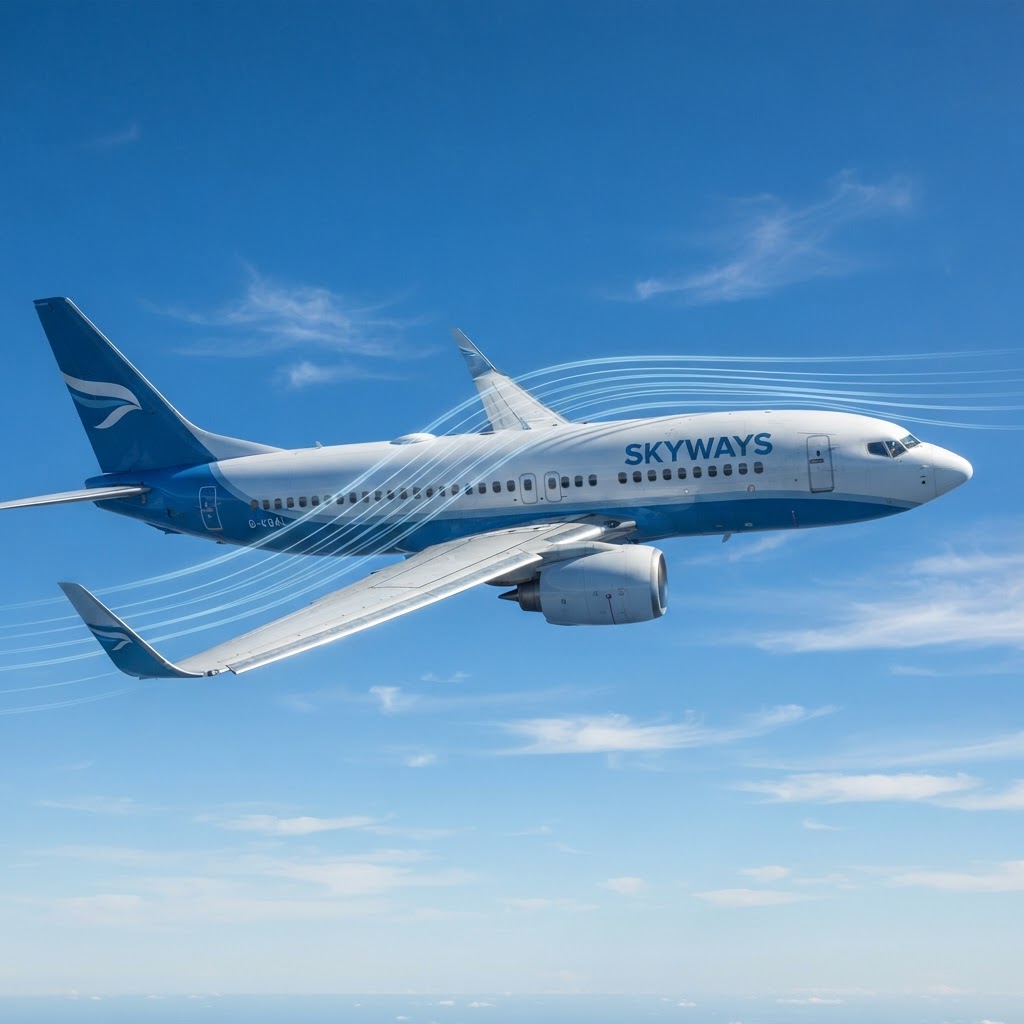
At its core, flight is a sophisticated interaction between an aircraft and the atmosphere. Airplanes utilize Bernoulli’s Principle and Newton’s Third Law of Motion to transition from a stationary position on the runway to high-speed travel through the troposphere. The shape of an airplane wing, known as an airfoil, is specifically engineered to divide the oncoming airflow. By forcing the air to travel faster over the curved top surface than the flatter bottom surface, the wing creates a pressure differential that supports the plane's mass. This phenomenon is supported by the engine's ability to provide constant forward motion, which ensures that air flows over the wings at a velocity sufficient to maintain altitude.
2. How It Works
Flight operation depends on a strict balance of numerical variables. Lift is mathematically defined by the formula L = 0.5 * rho * v^2 * S * Cl, where 'rho' is air density, 'v' is velocity, 'S' is wing area, and 'Cl' is the lift coefficient. For a Boeing 747-400 weighing approximately 875,000 pounds, the lift force must exactly match this weight during level flight. According to NASA’s Glenn Research Center, if the velocity (v) decreases, the pilot must increase the angle of attack to maintain the required lift coefficient, provided the aircraft has enough engine power to avoid a stall. A real-world example of this occurred during the Miracle on the Hudson in 2009, when US Airways Flight 1549 suffered total engine failure. The pilots had to maintain a specific pitch and speed ratio to maximize their glide ratio, effectively trading altitude for forward velocity until they could safely land the glider-like plane on the water. Modern avionics systems, such as the fly-by-wire technology used in the Airbus A320, continuously calculate these forces to assist pilots in maintaining optimal stability during turbulent weather conditions.
3. Why It Matters
Understanding these physics is essential for the evolution of aerospace engineering and sustainable-aviation. As engineers strive to design more efficient aircraft, they look at ways to reduce drag—the resistive force created by air friction—to lower fuel consumption. Lowering drag by even a small percentage can save millions of gallons of jet fuel annually for major international airlines. Beyond economics, mastering flight dynamics is a matter of safety, ensuring that aircraft can operate reliably in thin air at high altitudes or withstand the intense atmospheric pressure changes during takeoff and landing. This knowledge allows humanity to connect diverse cultures, transport critical medical supplies rapidly, and conduct scientific research in remote areas of the world.
| Force | Direction | Purpose | | :--- | :--- | :--- | | Lift | Upward | Counteracts gravity | | Weight | Downward | Pulls the aircraft to Earth | | Thrust | Forward | Provides propulsion | | Drag | Backward | Resists forward movement |
4. In Summary
Airplanes stay in the air by balancing lift, weight, thrust, and drag through precise engineering and pilot control. By manipulating airflow over shaped wings, aircraft achieve the necessary lift to overcome gravity and maintain stable, controlled flight at high speeds.
5. Further Reading
https://www.grc.nasa.gov/WWW/K-12/airplane/bern.html https://en.wikipedia.org/wiki/Lift_(force) https://www.noaa.gov/jetstream/atmosphere https://www.nature.com/subjects/aerospace-engineering
Common Misconceptions
Airplanes stay up because air travels faster over the top of the wing, creating low pressure.
While pressure differences occur, lift is fundamentally caused by the wing pushing air downward, which pushes the wing upward.
A plane can stay in the air at any speed as long as the engines are running.
An aircraft must maintain a specific 'stall speed' to generate enough lift to overcome its weight.
Frequently Asked Questions
What happens if an airplane loses engine power?
The plane becomes a glider and must maintain a specific airspeed to descend slowly enough to land safely.
Do all wings have the same shape?
No, wing shapes are specialized based on the aircraft's intended speed, efficiency, and maneuverability requirements.
What is the role of drag?
Drag is the air resistance that acts in opposition to the forward motion of the aircraft.
How do pilots control the altitude?
Pilots use flaps, ailerons, and elevators to change the wing's angle and surface area to manage lift.
Key Terms
- Airfoil
- The specific cross-sectional shape of a wing designed to produce lift.
- Angle of Attack
- The angle between the oncoming air stream and the chord line of the wing.
- Stall
- A condition where the airflow over the wing becomes separated, resulting in a sudden loss of lift.
- Thrust
- The forward force produced by a propulsion system that overcomes drag.
📖 Get AI explanations on related topics:
Explore How Do Airplanes Stay in the Air Flight Explained (2026) at every level
Get a How Do Airplanes Stay in the Air Flight Explained (2026) explanation tailored for Kid, Teen, and Expert levels — with cited sources and follow-up quizzes.
Explain How Do Airplanes Stay in the Air Flight Explained (2026) for me