Quantum Computing Explained for Beginners (2024 Guide) (2026)
In brief
Quantum computing uses quantum mechanics to solve problems classical computers can't. Here's a clear, beginner-friendly breakdown of what it is and why it matters.
Key Takeaways
- 1.Quantum computers use qubits — not classical bits — which exploit superposition to be 0 and 1 at the same time, enabling exponential computational power for specific problem types.
- 2.Three quantum phenomena drive this technology: superposition (multiple states), entanglement (linked qubits), and interference (amplifying correct answers).
- 3.Quantum computing will most impact drug discovery, cybersecurity, finance, and AI — but fault-tolerant, general-purpose quantum machines are still several years from widespread use.
Think of it like this
Think of a classical computer as a single explorer searching a massive library book by book to find one specific passage. A quantum computer is like sending millions of explorer-clones simultaneously into every aisle, every shelf, and every page at once — and all of them report back to you at the same moment, so you find the answer almost instantly.
Table of Contents
TITLE: Quantum Computing Explained for Beginners (2026 Guide) (2026) CONTENT: Quantum computing is a new type of computing that harnesses the principles of quantum mechanics — the science of subatomic particles — to process information in fundamentally different ways than the laptops and smartphones we use today. Instead of working with traditional binary bits (0s and 1s), quantum computers use quantum bits, or qubits, which can exist in multiple states simultaneously. This allows them to tackle certain complex problems exponentially faster than any classical machine.
For kids: Imagine a maze where a normal computer tries every path one at a time. A quantum computer tries all paths at once and finds the exit almost instantly.
1. What It Is
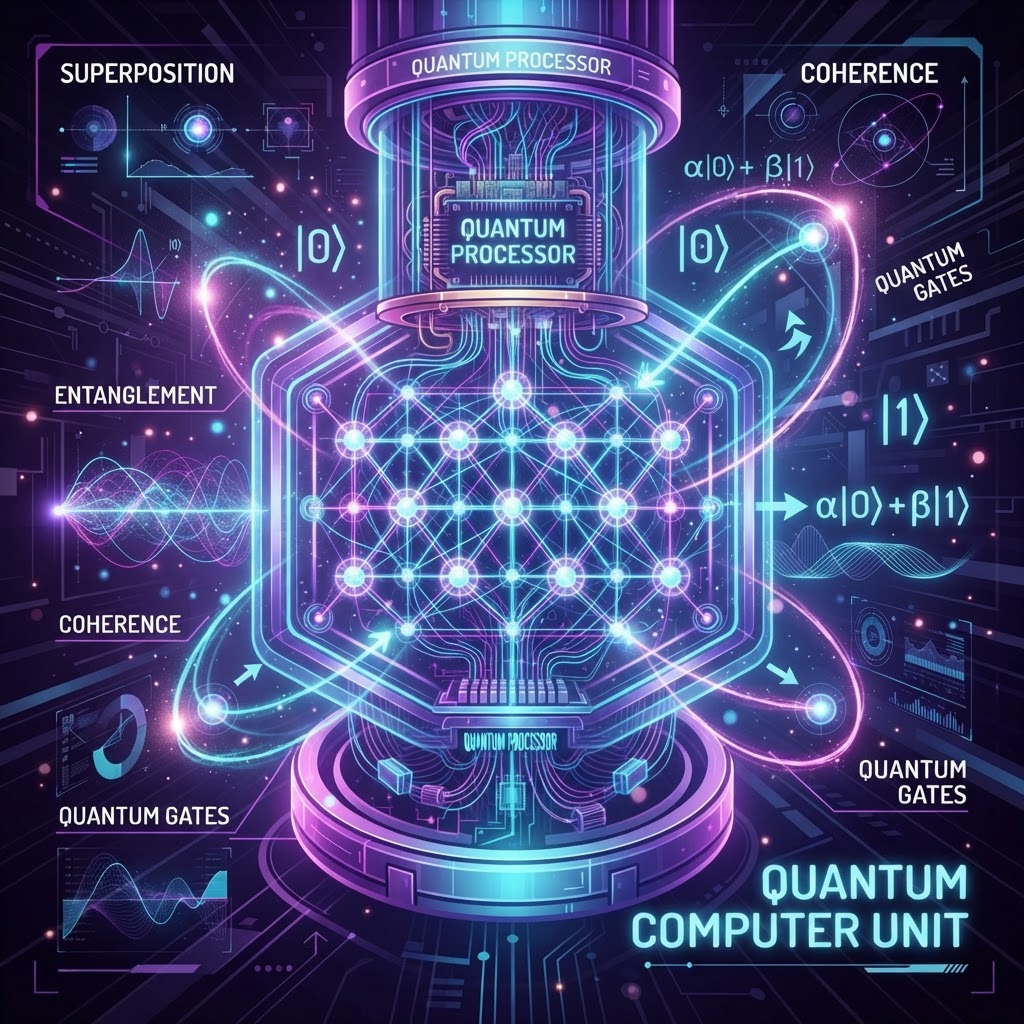
At its core, quantum computing is a method of computation that exploits quantum-mechanical phenomena such as superposition, entanglement, and interference. These are not just buzzwords — they are the physical rules that govern how particles like electrons and photons behave at the tiniest scales.
Classical computers — from your phone to the world's biggest supercomputers — store and process data as bits: each bit is either a 0 or a 1. A quantum computer replaces these with qubits, which, thanks to superposition, can be 0, 1, or both at the same time. When you combine multiple qubits and link them through entanglement, the computational power grows exponentially rather than linearly.
Quantum computers are not simply faster classical computers. They are architecturally different machines designed to excel at a specific class of problems — such as simulating molecular chemistry, cracking encryption algorithms, or optimising huge logistical networks.
2. How It Works
Three quantum properties make this type of computing possible:
- Superposition: A qubit can represent 0 and 1 simultaneously until it is measured, at which point it collapses to one value. This lets a quantum computer explore many solutions in parallel.
- Entanglement: Two qubits can be linked so that the state of one instantly influences the other, regardless of distance. This allows quantum computers to coordinate information in ways classical bits cannot.
- Interference: Quantum algorithms are designed to amplify paths leading to correct answers and cancel out paths leading to wrong ones, much like noise-cancelling headphones suppress unwanted sound.
Classical vs. Quantum Computing — At a Glance
| Feature | Classical Computer | Quantum Computer | |---|---|---| | Basic unit | Bit (0 or 1) | Qubit (0, 1, or both) | | Processing style | Sequential / parallel threads | Quantum parallelism | | Best at | General-purpose tasks | Optimisation, simulation, cryptography | | Error rate | Very low | Currently high (NISQ era) | | Availability | Universal | Specialist / cloud access | | Temperature needed | Room temperature | Near absolute zero (≈ −273 °C) |
Today's quantum machines are called NISQ devices (Noisy Intermediate-Scale Quantum), meaning they are powerful but still error-prone. Companies like IBM, Google, and IonQ are actively racing to achieve fault-tolerant quantum computing — the milestone where error correction is reliable enough for real-world deployment.
3. Why It Matters
The implications of scalable quantum computing span nearly every industry:
- Drug discovery & healthcare: Quantum computers can simulate the behaviour of molecules at the atomic level, potentially slashing the time to discover life-saving medicines from decades to years.
- Cryptography & cybersecurity: Quantum algorithms like Shor's algorithm could break widely used RSA encryption. This is prompting governments and organisations to develop post-quantum cryptography standards.
- Climate & energy: Optimising electrical grids, discovering better battery materials, and modelling climate systems are all areas where quantum advantage could prove transformative.
- Finance: Portfolio optimisation, fraud detection, and risk modelling involve combinatorial complexity that quantum systems could handle far more efficiently.
- Artificial intelligence: Quantum machine learning algorithms may dramatically accelerate training times for AI models.
The global quantum computing market is projected to exceed $450 billion by 2030 (McKinsey, 2026), signalling massive investment from both the private sector and national governments.
4. In Summary
Quantum computing is not science fiction — it is an emerging, real technology reshaping how we think about computation. By exploiting superposition, entanglement, and interference, quantum computers can solve certain problems that would take classical computers longer than the age of the universe. While practical, large-scale quantum computers are still years away for most applications, the foundational breakthroughs are happening right now. Understanding the basics today puts you ahead of the curve for tomorrow.
5. Further Reading
- IBM Quantum Learning — Free courses and documentation from one of the leading quantum hardware makers: https://learning.quantum.ibm.com
- Google Quantum AI — Research updates and explanations from Google's quantum division: https://quantumai.google
- Nature: Quantum Computing Overview — Peer-reviewed articles and explainers: https://www.nature.com/subjects/quantum-computing
- NIST Post-Quantum Cryptography — The US government's effort to build quantum-resistant encryption: https://csrc.nist.gov/projects/post-quantum-cryptography
Common Misconceptions
Quantum computers are just faster versions of regular computers and will replace your laptop soon.
Quantum computers are architecturally different and excel only at specific problem types (optimisation, simulation, cryptography). They will not replace classical computers for everyday tasks like browsing or word processing.
Quantum computing is purely theoretical with no real-world hardware existing yet.
Real quantum hardware exists today. IBM, Google, IonQ, and others operate quantum processors with dozens to hundreds of qubits, accessible via cloud platforms right now — though large-scale fault-tolerant machines are still in development.
Frequently Asked Questions
What is quantum computing in simple terms?
Quantum computing is a type of computing that uses the rules of quantum physics to process information using qubits, which can represent multiple states at once, allowing certain problems to be solved much faster than on a traditional computer.
How is a qubit different from a regular bit?
A classical bit is always either 0 or 1. A qubit, thanks to superposition, can be 0, 1, or a combination of both simultaneously until it is measured, giving quantum computers far greater information density.
Do quantum computers exist today?
Yes. Companies like IBM, Google, and IonQ have built real quantum processors. IBM's quantum systems are even accessible to the public via the cloud through IBM Quantum. However, they are still in the noisy, error-prone NISQ era.
Will quantum computers break the internet's encryption?
Potentially, yes — but not yet. Shor's algorithm could theoretically crack RSA encryption, but it would require millions of stable, error-corrected qubits. This is why NIST is already standardising post-quantum cryptographic algorithms as a precaution.
What temperature do quantum computers operate at?
Most quantum computers based on superconducting qubits must operate near absolute zero — around −273.15 °C (−459.67 °F) — which is colder than outer space. This extreme cooling minimises interference that would disrupt the qubits.
How long until quantum computers are mainstream?
Most experts estimate fault-tolerant, general-purpose quantum computers are 10–20 years away from widespread deployment. However, narrow quantum advantage for specific tasks (like chemistry simulation) could arrive much sooner, within 5–10 years.
Key Terms
- Qubit
- The fundamental unit of quantum information, analogous to a classical bit, but capable of existing in a superposition of 0 and 1 simultaneously until measured.
- Superposition
- A quantum mechanical principle where a particle — or qubit — can exist in multiple states at the same time, collapsing to a single definite state only upon observation.
- Entanglement
- A quantum phenomenon where two or more qubits become linked so that the state of one instantly determines the state of the other, regardless of the physical distance between them.
- NISQ (Noisy Intermediate-Scale Quantum)
- The current era of quantum computing, characterised by quantum processors with 50–1000+ qubits that are functional but still prone to errors due to environmental interference.
- Quantum Supremacy / Advantage
- The milestone at which a quantum computer solves a specific problem faster than any classical computer could — first claimed by Google in 2019 with its Sycamore processor.
📖 Get AI explanations on related topics:
Explore quantum computing at every level
Get a quantum computing explanation tailored for Kid, Teen, and Expert levels — with cited sources and follow-up quizzes.
Explain quantum computing for me