How Do Neural Networks Work? Explained Simply (2026)
In brief
Neural networks are AI systems inspired by the human brain. Learn how they learn, why they matter, and what makes them so powerful — explained simply.
Key Takeaways
- 1.Neural networks learn by adjusting millions of weighted connections through repeated exposure to labelled training data.
- 2.Backpropagation and gradient descent are the core mechanisms that allow a network to correct its own mistakes over time.
- 3.Deep learning — neural networks with many hidden layers — powers most modern AI breakthroughs, from image recognition to large language models.
Think of it like this
Think of a neural network like a panel of judges scoring a talent show. Each judge (neuron) notices different things — rhythm, vocals, stage presence. After each act, they compare notes, argue about who was wrong, and gradually calibrate their standards. After watching thousands of acts, their collective judgement becomes remarkably accurate.
TITLE: How Do Neural Networks Work? Explained Simply (2026) CONTENT: Neural networks are computational systems modelled loosely on the human brain. They learn to recognise patterns by processing data through layers of interconnected nodes, adjusting internal settings until their predictions improve. In short: they learn from examples, not explicit rules. For kids: Imagine teaching a dog new tricks by rewarding it every time it gets something right — neural networks learn the same way, getting "rewarded" when their answers are correct and adjusting until they get better.
1. What It Is
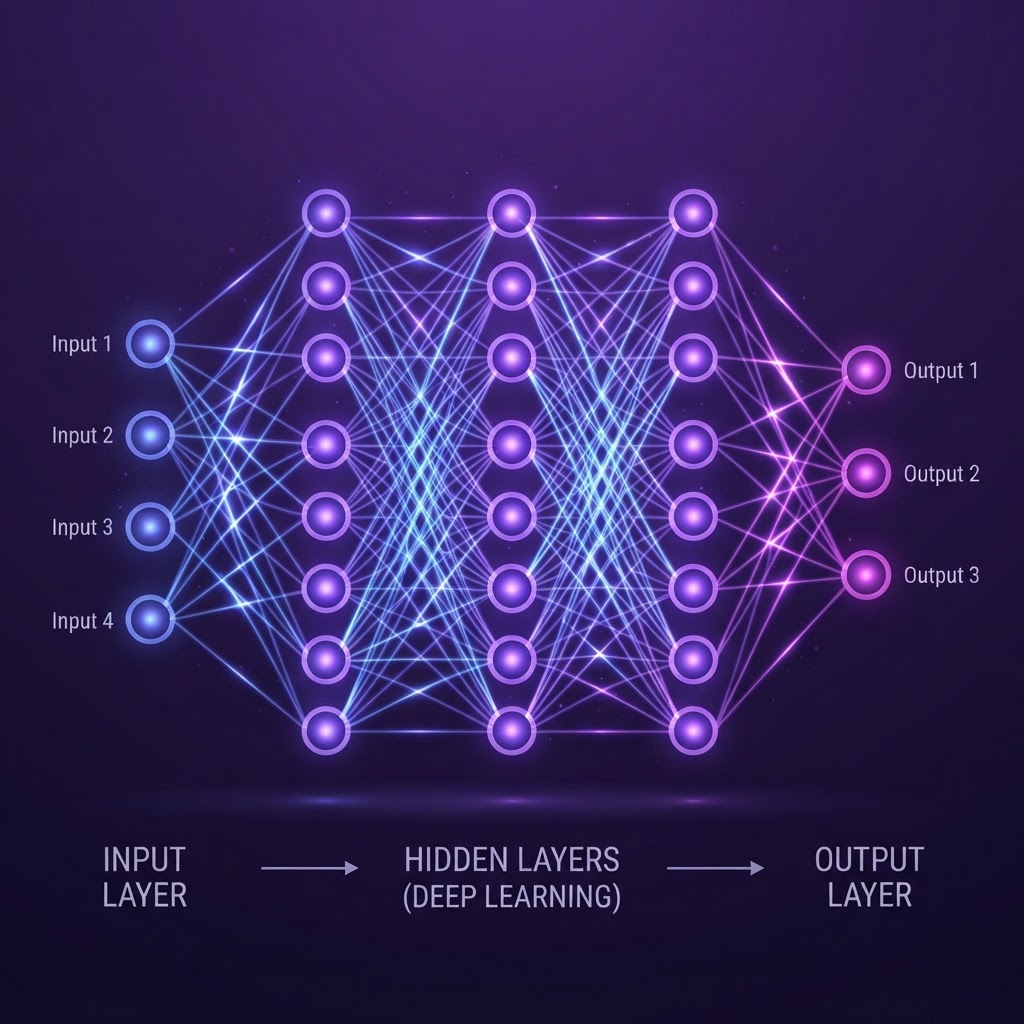
A neural network is a type of machine learning model made up of artificial neurons arranged in layers. These layers include:
- Input layer – receives raw data (e.g., pixels of an image)
- Hidden layers – process and transform the data through weighted connections
- Output layer – produces the final prediction or classification
Each connection between neurons carries a weight — a number that determines how much influence one neuron has on another. The network learns by fine-tuning these weights over thousands or millions of training examples.
Deep learning refers to neural networks with many hidden layers, giving them the ability to learn highly complex representations of data — from recognising faces to understanding spoken language.
2. How It Works
Training a neural network involves a cycle of three steps:
- Forward pass – data flows through the network and a prediction is made.
- Loss calculation – the prediction is compared to the correct answer using a loss function, which measures how wrong the model is.
- Backpropagation – the error is sent backwards through the network, and weights are adjusted using an algorithm called gradient descent.
This cycle repeats thousands of times until the network's predictions become reliably accurate.
| Concept | Simple Meaning | |---|---| | Weight | How strongly two neurons are connected | | Activation function | Decides whether a neuron "fires" or stays quiet | | Epoch | One full pass through all training data | | Overfitting | When a model memorises training data but fails on new data | | Gradient descent | The method used to nudge weights in the right direction |
Activation functions like ReLU (Rectified Linear Unit) introduce non-linearity, allowing the network to learn complex, curved decision boundaries rather than just straight lines.
3. Why It Matters
Neural networks power a remarkable range of real-world technologies:
- Natural language processing (NLP) – chatbots, translation tools, and voice assistants
- Computer vision – medical imaging, self-driving cars, and facial recognition
- Recommendation systems – Netflix, Spotify, and YouTube suggestions
- Drug discovery – predicting how molecules interact with proteins
The reason neural networks outperform older AI methods in many tasks is their ability to automatically extract useful features from raw data, removing the need for engineers to hand-craft rules. This scalability is why large language models (LLMs) like GPT-4 have billions of parameters and can perform impressively across diverse tasks.
However, neural networks are not magic. They require large amounts of labelled training data, significant computing power, and careful design to avoid problems like overfitting or bias in their outputs.
4. In Summary
Neural networks are layered systems of artificial neurons that learn from data by repeatedly adjusting weighted connections through backpropagation. They form the foundation of modern AI — from image classifiers to conversational agents. Their strength lies in learning patterns directly from raw data at scale, but they work best when paired with quality data, sound architecture choices, and responsible deployment.
Understanding the basics of how neural networks function is increasingly important — not just for engineers, but for anyone navigating a world being reshaped by artificial intelligence.
5. Further Reading
Common Misconceptions
Neural networks think and understand the way human brains do.
Neural networks are mathematical functions inspired loosely by the brain's structure, but they have no consciousness, understanding, or intent — they optimise for patterns in data, nothing more.
More data always makes a neural network better.
Quality matters as much as quantity. Poorly labelled, biased, or irrelevant data can make a neural network less accurate and introduce harmful errors in its predictions.
Frequently Asked Questions
What is a neural network in simple terms?
A neural network is a computer system that learns to make predictions by processing examples through layers of connected nodes, gradually improving by correcting its own errors.
How does a neural network learn?
It learns through a process called backpropagation — after making a prediction, it measures how wrong it was, then adjusts its internal weights to do better next time.
What is the difference between a neural network and deep learning?
Deep learning is a subset of machine learning that uses neural networks with many hidden layers. All deep learning uses neural networks, but not all neural networks are 'deep'.
Do neural networks require a lot of data?
Yes, most neural networks need large amounts of labelled training data to perform well. Insufficient data often leads to overfitting, where the model fails to generalise to new examples.
What are neural networks used for in everyday life?
They power smartphone face unlock, voice assistants like Siri and Alexa, email spam filters, streaming recommendations, and real-time language translation.
Can neural networks be wrong?
Absolutely. Neural networks can make confident but incorrect predictions, especially with unusual inputs or when trained on biased data. Human oversight remains essential.
Key Terms
- Neuron
- An individual computational unit in a neural network that receives inputs, applies a weighted sum, and passes the result through an activation function.
- Backpropagation
- An algorithm that calculates how much each weight contributed to the prediction error and adjusts them accordingly to improve future accuracy.
- Gradient Descent
- An optimisation technique that iteratively updates network weights in the direction that most reduces the prediction error.
- Overfitting
- A problem where a neural network learns the training data too precisely and performs poorly on new, unseen data.
- Activation Function
- A mathematical function applied to a neuron's output to introduce non-linearity, enabling the network to learn complex patterns.
Written by
Priya Sharma
AI & Technology Editor
Priya Sharma is the AI & Technology Editor at ExplainItSimple.AI. She holds a BSc in Computer Science from IIT Delhi and has worked as a machine learning engineer before moving to science communication. She specializes in making AI, software, and emerging tech understandable without a CS degree.
BSc Computer Science, IIT Delhi
View full profile📖 Get AI explanations on related topics:
Explore neural networks at every level
Get a neural networks explanation tailored for Kid, Teen, and Expert levels — with cited sources and follow-up quizzes.
Explain neural networks for me