
How Does 3D Printing Work? (2026)
In brief
3D printing is an additive manufacturing process that creates objects by layering materials like plastic, metal, or resin from a digital file.
Key Takeaways
- 1.3D printing uses additive manufacturing, which builds objects layer-by-layer rather than cutting material away like traditional subtractive methods.
- 2.The process begins with a 3D digital model, typically saved as an STL file, which provides the printer with geometric instructions.
- 3.Diverse materials are used, including thermoplastics like PLA, photopolymer resins, and metal powders, depending on the specific printer technology.
Think of it like this
3D printing is like a hot glue gun controlled by a robot that builds a statue from the bottom up by stacking thousands of invisible, precise layers.
3D printing, scientifically known as additive manufacturing, is a revolutionary technology that creates three-dimensional solid objects from a digital file by depositing material layer by layer. Unlike traditional subtractive manufacturing methods—such as milling or turning, which remove excess material from a solid block—this process builds components from the ground up, reducing waste and allowing for the creation of complex geometries that were previously impossible to produce. By utilizing digital blueprints generated through computer-aided design (CAD) software, engineers and hobbyists alike can transform virtual models into tangible, functional products in a matter of hours. This technology has permeated various sectors, from aerospace engineering and medical prosthetics to rapid prototyping for consumer electronics, fundamentally altering how humanity approaches industrial design and production cycles.
For kids: 3D printing is like using a super-precise, computerized glue gun that draws shapes in layers until a solid toy or tool is built from the bottom up.
1. What It Is
At its core, 3D printing is an additive process that requires a digital model to act as a guide for the physical construction of an object. The machine reads a 3D file, typically saved in an STL or OBJ format, and slices the design into hundreds or thousands of thin, horizontal horizontal layers. These cross-sections serve as a stackable roadmap for the print head or laser, which deposits materials such as thermoplastic polymers, metal powders, or specialized resins. This layering technique allows for significant customization, as the digital file can be altered in seconds to adjust dimensions, wall thickness, or internal supports before the next print begins. Because the object is built incrementally, manufacturers can embed internal structures like honeycomb lattices, which drastically reduce the weight of a component while maintaining high structural integrity.
2. How It Works
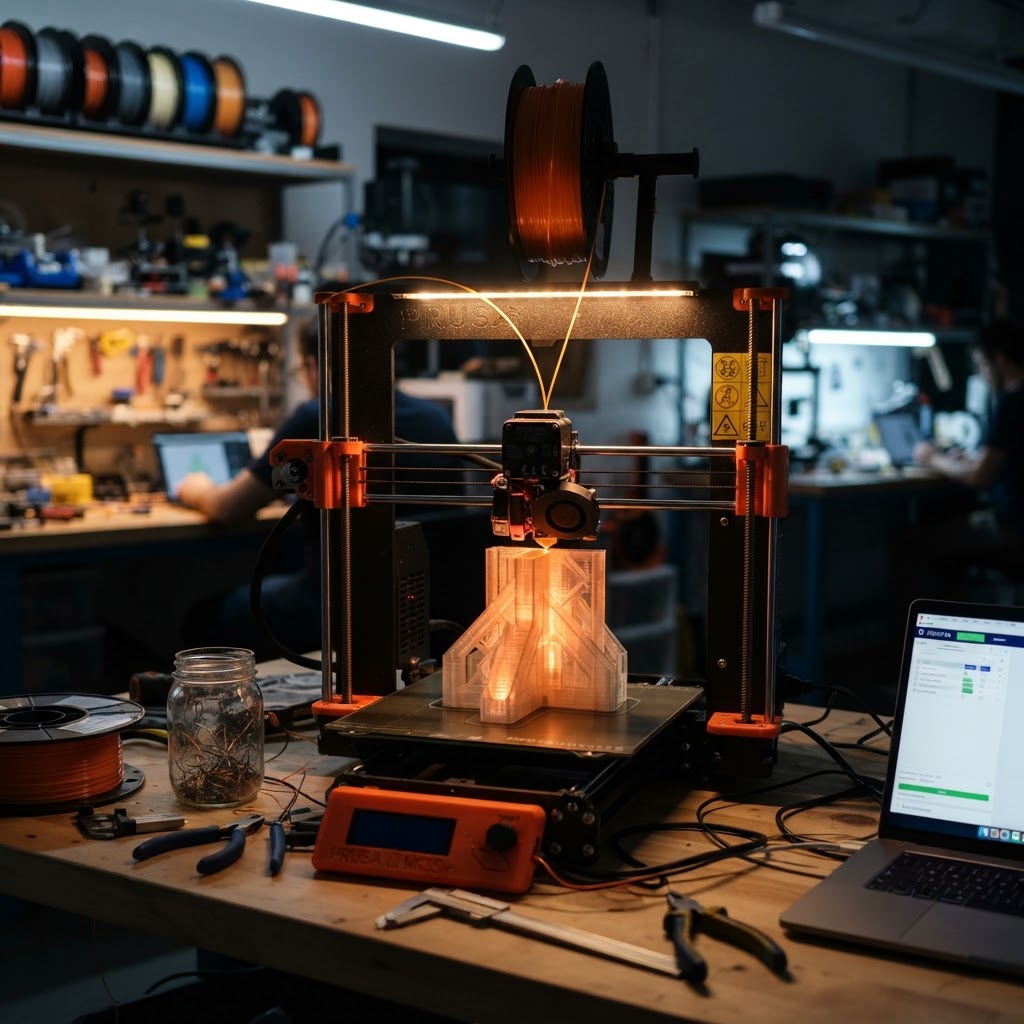
The mechanism of a 3D printer varies by technology, but most desktop machines use Fused Deposition Modeling (FDM). According to research by ASTM International (ISO/ASTM 52900), this process involves heating a thermoplastic filament to its melting point and extruding it through a nozzle onto a build platform. The material hardens instantly, forming a solid base for the next layer. In industrial settings, Selective Laser Sintering (SLS) is often used, where a high-powered laser fuses thin layers of powdered metal or nylon, allowing for even higher precision. A landmark real-world example is the use of 3D printing by General Electric (GE) to manufacture fuel nozzles for their LEAP aircraft engines. By 3D printing these complex parts as a single piece, GE reported a 25% weight reduction and improved durability compared to the traditional assembly process, which previously required soldering 20 different components together.
3. Why It Matters
3D printing is a catalyst for democratizing rapid prototyping and localizing manufacturing. In the healthcare industry, surgeons are now able to 3D print patient-specific anatomical models for surgical planning, significantly reducing operating room time and enhancing success rates. For supply chains, the technology provides a buffer against shortages; instead of shipping parts across the globe, companies can store digital files in a cloud-based server and print needed components on-site within hours. This "just-in-time" production model minimizes inventory costs and eliminates the necessity for expensive storage warehouses. Furthermore, additive manufacturing drastically reduces carbon footprints by minimizing the amount of scrap metal or plastic waste generated during the production phase of complex machine parts.
| Feature | Traditional Manufacturing | 3D Printing (Additive) | | :--- | :--- | :--- | | Material Usage | Subtractive (High waste) | Additive (Low waste) | | Geometry Complexity | Limited | Extremely high | | Speed (Small scale) | Slow (Tooling needed) | Fast (On-demand) | | Initial Setup Cost | High | Low |
4. In Summary
3D printing transforms digital designs into physical realities through a layer-by-layer additive process that maximizes efficiency and design freedom. As materials and speed continue to advance, this technology is set to redefine modern supply chains and personalized manufacturing across the globe.
5. Further Reading
- https://en.wikipedia.org/wiki/3D_printing
- https://www.nasa.gov/technology/manufacturing/3d-printing/
- https://www.noaa.gov/stories/how-3d-printing-is-changing-science-at-noaa
- https://www.nature.com/articles/s41578-021-00358-1
Common Misconceptions
3D printing is only for making cheap plastic toys.
3D printing is widely used in aerospace, medicine, and automotive industries to create high-strength, functional parts for jet engines and medical implants.
Any digital image can be 3D printed immediately.
You need a specialized 3D model with 'watertight' geometry; a standard 2D photograph or image cannot be printed without being converted into a 3D volume.
Frequently Asked Questions
What is the most common type of 3D printing?
Fused Deposition Modeling (FDM) is the most popular method for hobbyists and educators because it is affordable and uses common plastic filaments.
How long does a 3D print take?
Print times vary based on the object's size, detail level, and speed settings, ranging from 30 minutes for simple items to several days for large, complex structures.
Can 3D printers print in color?
Some industrial printers can mix materials or use multi-color filaments, but most standard printers use one color of material at a time.
Is 3D printing environmentally friendly?
It can be more efficient than traditional methods because it uses only the material needed for the object, reducing waste, though the plastics used are often non-biodegradable.
What is an STL file?
An STL file is a common file format that describes the surface geometry of a 3D object using a collection of triangles.
Key Terms
- Additive Manufacturing
- The process of joining materials to make objects from 3D model data, usually layer upon layer.
- Filament
- The thermoplastic material fed into an FDM printer, usually provided on a spool.
- Slicing
- The process of converting a 3D model into specific G-code instructions that tell the printer where to move.
- Extruder
- The part of the printer that heats and pushes the material through a nozzle to form the print.
Written by
Priya Sharma
AI & Technology Editor
Priya Sharma is the AI & Technology Editor at ExplainItSimple.AI. She holds a BSc in Computer Science from IIT Delhi and has worked as a machine learning engineer before moving to science communication. She specializes in making AI, software, and emerging tech understandable without a CS degree.
BSc Computer Science, IIT Delhi
View full profile📖 Get AI explanations on related topics:
Explore technology at every level
Get a technology explanation tailored for Kid, Teen, and Expert levels — with cited sources and follow-up quizzes.
Explain technology for me