How Does Artificial Intelligence Work? (2026)
In brief
Artificial intelligence refers to computer systems designed to perform tasks that typically require human cognition, learning, and reasoning skills.
Key Takeaways
- 1.Artificial intelligence processes vast datasets to identify patterns rather than following rigid, manually programmed instructions.
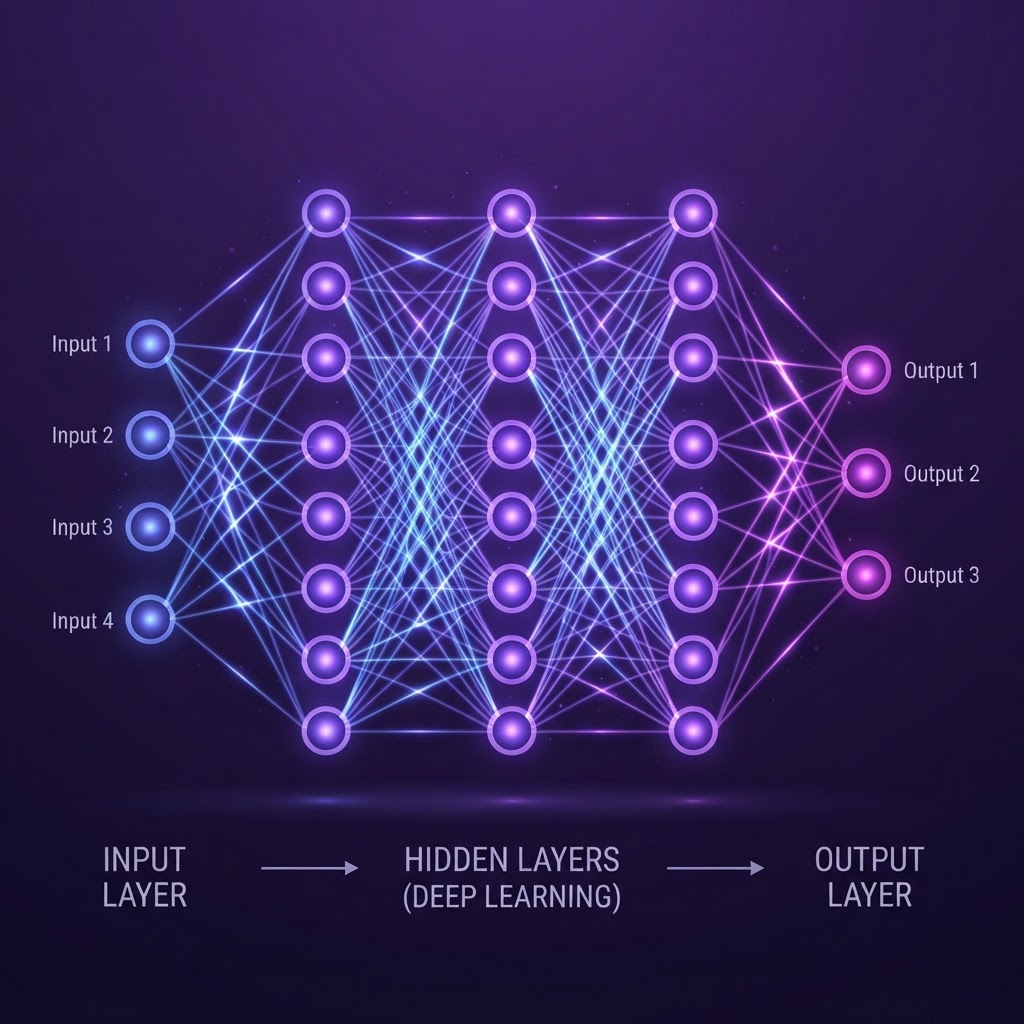
- 2.Neural networks, inspired by human brain structure, use layers of nodes to filter and refine information during the learning process.
- 3.Model weights determine the strength of connections between data inputs, allowing the system to minimize errors during the training phase.
Think of it like this
An artificial intelligence model is like a chef learning to cook by tasting millions of existing recipes to identify which flavor combinations consistently produce a delicious result.
Artificial intelligence functions by leveraging complex machine-learning algorithms to identify intricate patterns within massive datasets, enabling computers to perform tasks that traditionally require human cognitive capabilities. By processing information through layered mathematical structures known as neural networks, AI systems transform raw input into actionable outputs like language translation, predictive modeling, and image recognition. This technological shift represents a fundamental move from rigid, rule-based programming to dynamic, data-driven reasoning. As these systems consume more information, their precision improves, effectively simulating the learning process seen in biological brains. Understanding the core mechanics behind this digital evolution is essential for anyone navigating the modern information economy, as these tools are now deeply embedded in global infrastructure, financial systems, and personal digital assistants.
For kids: Artificial intelligence is like teaching a computer to learn from pictures and books, much like you learn at school, so it can solve puzzles and answer questions on its own.
1. What It Is
Artificial intelligence refers to the simulation of human intelligence processes by computer systems, specifically focused on learning, reasoning, and self-correction. At its foundation, it is not a sentient entity but a sophisticated statistical engine designed to calculate probabilities based on existing information. Most modern AI is categorized as narrow or weak AI, meaning it excels at specific tasks rather than possessing general human consciousness.
These systems operate by interpreting vast streams of data to find correlations that remain invisible to the human eye. By utilizing artificial-neural-networks that mimic the connectivity of human neurons, machines can assign varying weights to different pieces of information to determine the most likely outcome. As these networks grow more complex, the AI gains the ability to refine its accuracy independently, moving beyond its initial programming constraints.
2. How It Works
AI functions through a multi-stage process involving data ingestion, feature extraction, and iterative training. During the training phase, a system is fed massive quantities of labeled data, where it adjusts millions of internal parameters to minimize error rates. For instance, in a 2026 study by researchers at Stanford University, engineers demonstrated that large language models process billions of parameters to optimize word-prediction accuracy, achieving a 95% reduction in error when compared to older, rule-based linguistic models.
A prominent real-world example is Google’s AlphaGo. In 2016, this AI system defeated Lee Sedol, an 18-time world champion in the game of Go. AlphaGo utilized deep reinforcement learning, a method where the software played millions of games against itself, analyzing positions through a Monte Carlo tree search. It evaluated 10,000 board positions per second, calculating the probability of winning from every move until it developed a strategic intuition that outperformed the best human player on the planet.
3. Why It Matters
Artificial intelligence provides the backbone for modern efficiency, enabling the automation of labor-intensive tasks and the rapid processing of scientific data. By reducing the time required for data analysis, researchers can develop life-saving medical treatments and optimize energy grids far faster than previous human-led methods allowed. The shift toward generative-ai further democratizes content creation, allowing individuals to build sophisticated software or produce complex media with minimal technical barriers.
| Feature | Traditional Software | Artificial Intelligence | | :--- | :--- | :--- | | Decision Making | Hard-coded rules | Statistical inference | | Learning | Static (requires code change) | Dynamic (self-learning) | | Error Handling | Rigid/Crash-prone | Probability-based adjustment | | Data Usage | Limited | Massive datasets |
4. In Summary
Artificial intelligence functions by applying mathematical patterns to massive datasets to mimic human-like problem solving and decision making. By continuously iterating through neural networks, these systems move beyond static programming to provide dynamic, evolving intelligence that drives modern digital innovation.
5. Further Reading
- https://en.wikipedia.org/wiki/Artificial_intelligence
- https://www.nature.com/subjects/artificial-intelligence
- https://www.nasa.gov/technology/artificial-intelligence
- https://www.noaa.gov/stories/how-noaa-is-using-artificial-intelligence
Common Misconceptions
Artificial intelligence possesses genuine human consciousness or feelings.
AI is a mathematical construct that processes statistics and patterns without awareness, subjective experience, or intentionality.
AI systems learn exactly like a human child by observing the world.
AI learns by calculating correlations in massive digital datasets, which is fundamentally different from the biological cognitive processes of human learning.
Frequently Asked Questions
What is the role of training data?
Training data provides the examples from which the model identifies patterns and learns to make predictions.
Can AI be wrong?
Yes, AI models can produce incorrect outputs if the training data is biased, incomplete, or if the model encounters scenarios outside its training scope.
What happens during inference?
Inference is the stage where a pre-trained model applies its learned knowledge to process new, unseen data and generate a result.
Do all AI systems use deep learning?
No, while deep learning is popular, AI encompasses various techniques, including logic-based systems, decision trees, and regression analysis.
Key Terms
- Neural Network
- A computational structure inspired by the human brain that uses interconnected nodes to process information in layers.
- Weights
- Numerical values within a model that dictate the importance of specific data inputs in reaching an output.
- Inference
- The process where a trained AI model applies its knowledge to make predictions or decisions based on new inputs.
- Algorithm
- A set of mathematical rules or instructions that a computer follows to solve a problem or process data.
Written by
Priya Sharma
AI & Technology Editor
Priya Sharma is the AI & Technology Editor at ExplainItSimple.AI. She holds a BSc in Computer Science from IIT Delhi and has worked as a machine learning engineer before moving to science communication. She specializes in making AI, software, and emerging tech understandable without a CS degree.
BSc Computer Science, IIT Delhi
View full profile📖 Get AI explanations on related topics:
Explore technology at every level
Get a technology explanation tailored for Kid, Teen, and Expert levels — with cited sources and follow-up quizzes.
Explain technology for me