What Is DNA and How Does It Work? (2026)
In brief
DNA, or deoxyribonucleic acid, is a molecule that stores the hereditary biological instructions required to build and regulate living organisms.
Key Takeaways
- 1.DNA is composed of 3 billion base pairs organized into roughly 20,000 genes.
- 2.The sequence of four chemical bases (A, T, G, C) determines the specific proteins produced by a cell.
- 3.Only about 2% of human DNA codes for proteins, while the remainder plays critical roles in gene regulation.
Think of it like this
DNA acts as a massive library of blueprints where genes are individual instruction manuals, and the resulting proteins are the specialized machines built to perform every task in your body.
Table of Contents
Deoxyribonucleic acid, commonly known as DNA, serves as the fundamental instruction manual for every living organism on Earth, dictating everything from your eye color to the complex metabolic processes sustaining your cells. Located within the nucleus of nearly every cell in the human body, this double-helix molecule carries the hereditary blueprint passed down through generations. By understanding how this intricate biological code functions, scientists can unlock breakthroughs in medicine, forensics, and evolutionary biology, revealing the shared ancestry of all life forms. This article explores the structural composition of DNA and the precise mechanisms that allow it to direct the biological activities necessary for life.
For kids: DNA is like a giant, microscopic recipe book kept inside your body that tells your cells exactly how to build and operate every part of you.
1. What It Is
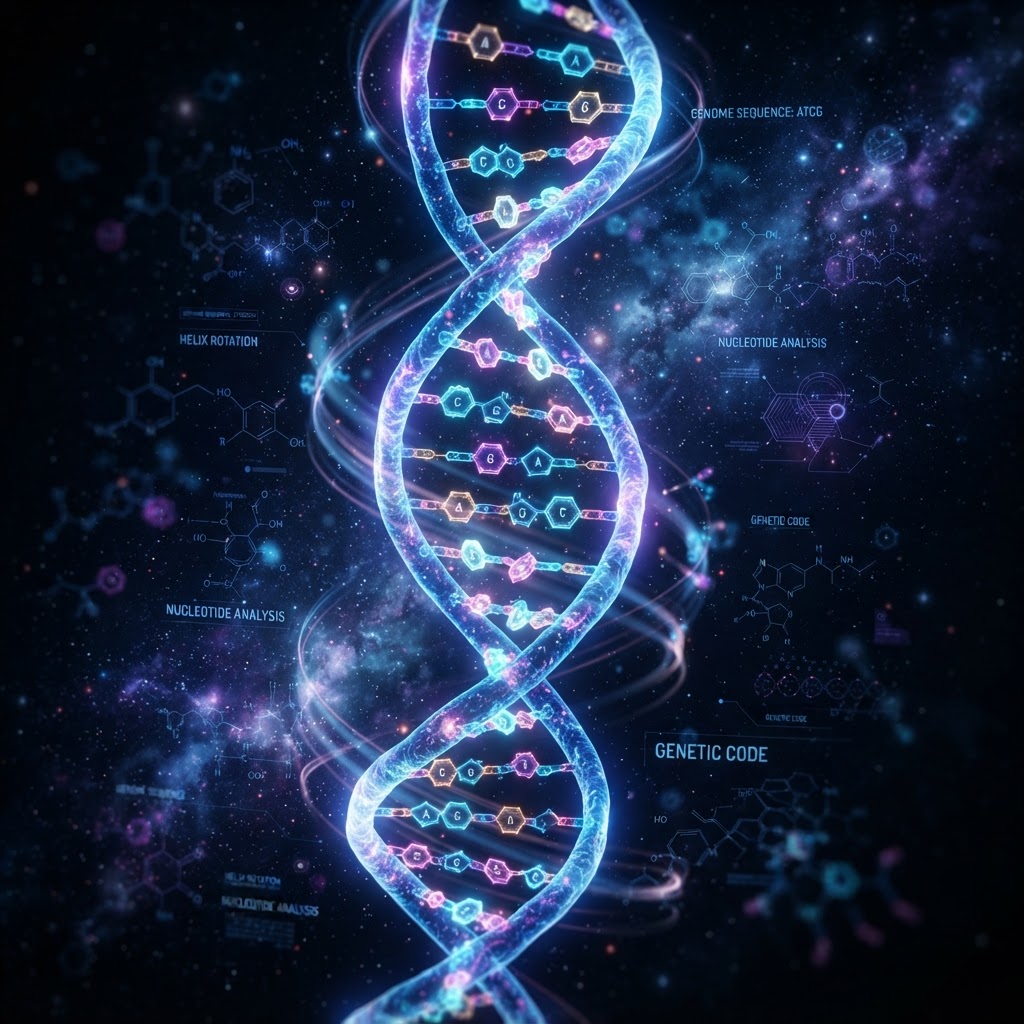
DNA is a complex molecule composed of two long, twisted strands that form a shape known as a double helix. The backbone of these strands consists of alternating sugar and phosphate groups, which provide the structural stability necessary to protect the delicate genetic information stored inside. Attached to each sugar molecule is one of four chemical bases: adenine, thymine, cytosine, or guanine, often abbreviated as A, T, C, and G.
These four bases act as the letters of the genetic alphabet, and their specific sequence determines the biological traits of an organism. While the physical structure might appear simple, the complexity arises from the vast number of base pairs, with a single human cell containing approximately 3.2 billion base pairs of DNA. This massive amount of data must be tightly coiled and packaged into structures called chromosomes to fit within the microscopic confines of the cell nucleus. The sequence of these bases functions much like a digital code, providing instructions for the synthesis of proteins, which are the building blocks of life.
2. How It Works — specific numbers and named sources inline, AND one named real-world example
DNA functions through the process of replication and transcription, a mechanism first elucidated by James Watson and Francis Crick in their 1953 Nature paper. During replication, the double helix unzips, and specialized enzymes such as DNA polymerase read each strand to create a complementary copy with over 99.9% accuracy. This precise duplication is essential for cell division, allowing an organism to grow and repair tissues by ensuring each new cell has an identical copy of the genome.
According to the National Human Genome Research Institute, the human genome contains between 20,000 and 25,000 genes, each acting as a segment of DNA that provides instructions for making proteins. A famous real-world application of this knowledge is the Human Genome Project, an international research effort that successfully mapped all 3 billion DNA base pairs in the human genome by 2003. This massive achievement provided the foundation for personalized medicine, where doctors can now analyze an individual's unique genetic code to predict disease susceptibility or optimize pharmaceutical treatments. By utilizing advanced sequencing technology, researchers can identify specific mutations, like those linked to cystic fibrosis or Huntington’s disease, and develop targeted therapies that address the underlying genetic error.
3. Why It Matters
The significance of DNA extends far beyond basic biology, influencing fields ranging from criminology to climate change adaptation. Because each person possesses a unique genetic sequence—excluding identical twins—forensic scientists use genetic-fingerprinting to identify suspects or exonerate the innocent in legal proceedings. In agriculture, scientists manipulate DNA to create drought-resistant crops, ensuring food security for a growing global population that is expected to reach nearly 10 billion by 2050.
Furthermore, studying the DNA of extinct and endangered species allows conservationists to understand evolutionary history and preserve biodiversity. By comparing the genetic markers across different populations, researchers can track the migration patterns of ancient humans or assess the health of fragile ecosystems impacted by habitat loss. Understanding these sequences ultimately provides a mirror into our own past and a guide for our future medical and environmental interventions.
| Feature | DNA | RNA | | :--- | :--- | :--- | | Structure | Double Helix | Single Strand | | Sugar Type | Deoxyribose | Ribose | | Base Pair | A, T, C, G | A, U, C, G | | Primary Role | Long-term storage | Protein Synthesis |
4. In Summary
DNA serves as the master blueprint for all biological life, encoding the instructions necessary for development, survival, and reproduction through a unique sequence of chemical bases. By leveraging our understanding of this molecular code, humanity has achieved unprecedented control over disease and biological exploration, transforming how we approach healthcare and evolutionary science.
5. Further Reading
https://en.wikipedia.org/wiki/DNA https://www.genome.gov/about-genomics/fact-sheets/Deoxyribonucleic-Acid-Fact-Sheet https://www.nature.com/scitable/topicpage/dna-as-the-genetic-material-17173646 https://www.nature.com/scitable/topicpage/discovery-of-dna-structure-and-function-397/
Common Misconceptions
DNA that does not code for proteins is useless 'junk'.
Non-coding DNA contains vital regulatory sequences that act as 'switches' to control when and how genes are expressed.
All DNA mutations result in harmful genetic diseases.
Many mutations are silent and have no effect, while others can be beneficial or neutral, playing a key role in the process of evolution.
Frequently Asked Questions
What does DNA stand for?
DNA stands for deoxyribonucleic acid, which is a molecule that carries the genetic instructions for all living things.
Where is DNA found in the human body?
DNA is primarily found inside the nucleus of almost every cell in the human body, with a small amount also found in the mitochondria.
How much DNA do humans share?
All humans share approximately 99.9% of their DNA sequence, with the remaining 0.1% accounting for individual differences.
Can DNA change over time?
Yes, DNA sequences can change through mutations, which are alterations to the chemical code that can occur due to environmental factors or replication errors.
Do all living organisms have DNA?
Yes, all known living organisms, including plants, animals, bacteria, and fungi, use DNA to store their genetic information.
Key Terms
- Double Helix
- The physical structure of DNA, which resembles a twisted ladder or spiral staircase.
- Nucleotide
- The basic structural unit of DNA consisting of a sugar, a phosphate group, and one of four nitrogenous bases.
- Transcription
- The process by which the information in a strand of DNA is copied into a new molecule of messenger RNA.
- Mutation
- A change in the DNA sequence of an organism.
📖 Get AI explanations on related topics:
Explore DNA at every level
Get a DNA explanation tailored for Kid, Teen, and Expert levels — with cited sources and follow-up quizzes.
Explain DNA for me