What Is Quantum Computing? A Beginner's Guide (2026)
In brief
Quantum computing uses quantum mechanics to process information in ways that classical computers cannot achieve by leveraging subatomic particles.
Key Takeaways
- 1.Quantum computers use qubits instead of traditional bits.
- 2.Superposition allows quantum systems to represent multiple states at once.
- 3.Quantum entanglement links particles across distances regardless of space.
Think of it like this
A classical computer is like a person walking through a maze one path at a time, whereas a quantum computer is like a mist that explores every path simultaneously to find the exit.
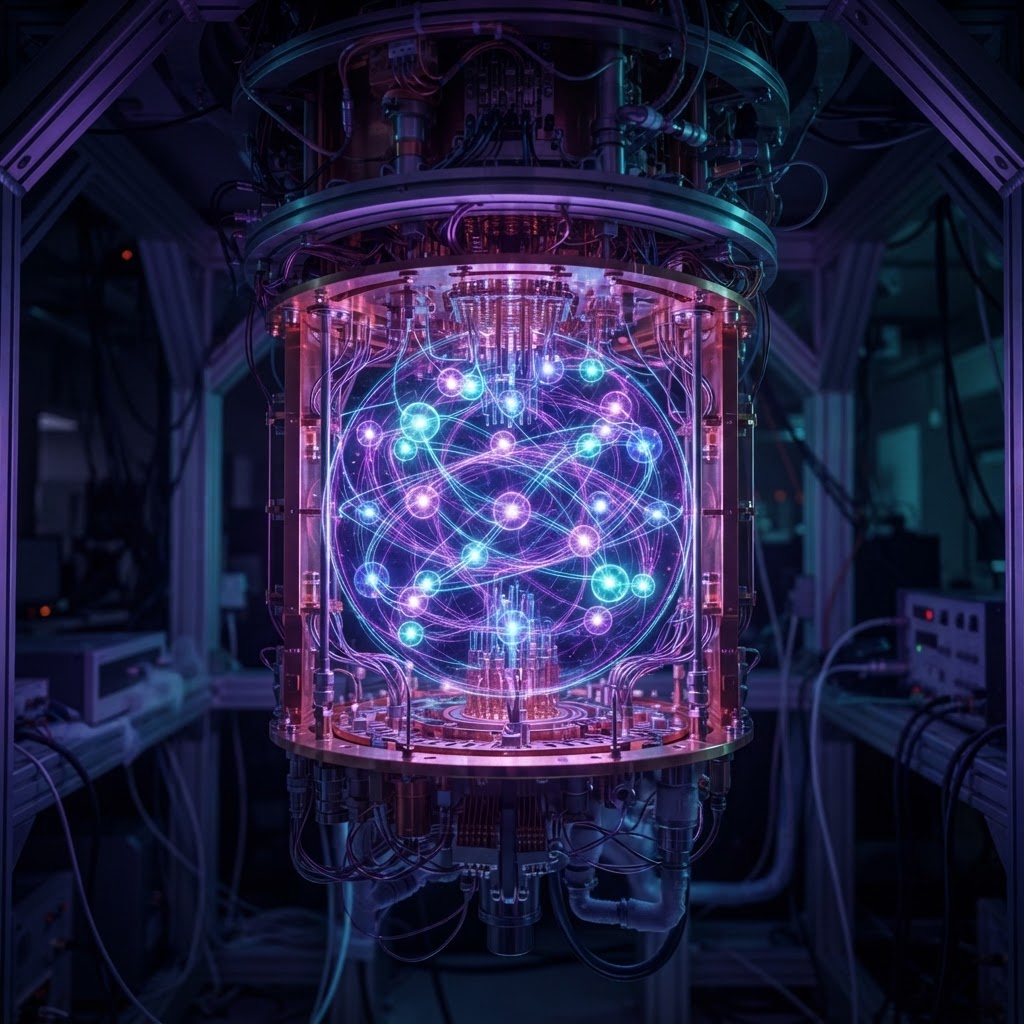
Quantum computing represents a revolutionary leap in information processing, moving beyond the binary constraints of classical hardware to harness the strange phenomena of subatomic physics. By utilizing quantum bits, known as qubits, these advanced systems can perform complex calculations at speeds that would take traditional supercomputers thousands of years to complete. As global industries scramble to integrate these processors, the core mechanism lies in the ability to hold multiple states simultaneously, effectively allowing a quantum computer to explore a vast landscape of potential solutions in parallel. This paradigm shift does not merely increase speed; it fundamentally alters the way we approach unsolvable problems in mathematics, cryptography, and molecular chemistry. Researchers at leading institutions are now racing to move from theoretical models to fault-tolerant, scalable architectures that can handle real-world tasks. As the field matures, the transition from classical binary-logic to quantum probability will become the most significant advancement in computational power since the invention of the vacuum tube. For kids: Imagine a normal computer uses a light switch that is either on or off, but a quantum computer uses a dimmer switch that can be partially on and off in many ways at once, allowing it to solve super hard puzzles much faster. ## 1. What It Is Quantum computing is a field of study focused on developing computer technology based on the principles of quantum theory. While classical computers process information in bits represented as either a 0 or a 1, quantum systems utilize qubits which leverage superposition to exist in multiple states at once. This capacity is augmented by entanglement, a physical phenomenon where pairs of particles remain connected such that the state of one instantly influences the state of the other, regardless of distance. These properties allow for a massive increase in the state space that a machine can navigate. By manipulating these quantum states, scientists can execute algorithms that are exponentially more efficient for specific classes of problems than any silicon-based chip available today. ## 2. How It Works — specific numbers and named sources inline, AND one named real-world example Quantum computing functions by applying sequences of quantum logic gates to qubits, creating an interference pattern that amplifies the correct answer while canceling out incorrect ones. According to a landmark 2019 study published by Nature, Google's Sycamore processor achieved what is termed 'quantum supremacy' by completing a calculation in 200 seconds that would have supposedly taken the world's most powerful supercomputer, IBM’s Summit, approximately 10,000 years to verify. The process involves cooling the quantum processor to temperatures near absolute zero, roughly 0.015 Kelvin, to maintain the stability of the fragile quantum state. A practical, real-world application can be seen in the work of Volkswagen, which collaborated with D-Wave Systems to optimize traffic routing for buses in Beijing. By using quantum-inspired algorithms to simulate thousands of potential routes simultaneously, the company aimed to drastically reduce congestion in dense urban environments. This demonstrates how quantum approaches, even in their infancy, can outperform traditional optimization-algorithms by evaluating global variables in a single processing step. ## 3. Why It Matters Quantum computing matters because it unlocks capabilities that are currently locked behind physical barriers of processing speed and memory capacity. In the pharmaceutical industry, the ability to model complex molecular interactions at the atomic level could shorten drug discovery timelines from a decade to a few months. Furthermore, current RSA encryption relies on the difficulty of factoring large prime numbers, a task that quantum algorithms like Shor’s Algorithm could eventually perform in minutes. This forces a global rethink of cybersecurity protocols to prepare for a post-quantum landscape. Beyond security, it promises to revolutionize material-science by simulating high-temperature superconductors, which could lead to near-perfect energy storage and transmission efficiency. | Feature | Classical Computer | Quantum Computer | | :--- | :--- | :--- | | Core Unit | Bit (0 or 1) | Qubit (0, 1, or both) | | Logic | Boolean Algebra | Linear Algebra / Probability | | Speed | Linear growth | Exponential growth | | Best Use | Everyday tasks | Complex simulations | ## 4. In Summary Quantum computing harnesses the subatomic rules of nature to process data in ways that defy classical physical limits. By mastering the delicate states of qubits, humanity is unlocking a new era of scientific simulation, cryptographic security, and unparalleled computational speed. ## 5. Further Reading https://en.wikipedia.org/wiki/Quantum_computing https://www.nasa.gov/quantum-computing-at-nasa https://www.nature.com/articles/s41586-019-1666-5 https://www.nist.gov/quantum
Common Misconceptions
Quantum computers will replace every laptop and smartphone.
They are specialized tools designed for complex simulations and cryptography, not for daily web browsing or word processing.
Quantum computers just run faster because they do everything at once.
They solve specific mathematical problems more efficiently through probability, rather than just brute-forcing all possibilities simultaneously.
Frequently Asked Questions
What is a qubit?
A qubit, or quantum bit, is the basic unit of information in quantum computing that can exist as 0, 1, or both simultaneously.
Why do they need to be extremely cold?
Qubits are fragile and prone to interference from heat or electromagnetic noise, so they must be kept near absolute zero to maintain stability.
Are quantum computers faster than supercomputers?
They are exponentially faster for specific tasks like prime factorization, but they are not faster at general tasks like database management.
Can I buy a quantum computer today?
No, they are massive, experimental machines that require specialized cooling systems and are only accessible via cloud services.
Key Terms
- Superposition
- The ability of a quantum system to exist in multiple states at the same time until it is measured.
- Entanglement
- A phenomenon where two particles become linked so that the state of one instantly influences the state of the other.
- Decoherence
- The loss of quantum state stability caused by interaction with the surrounding environment.
Written by
Priya Sharma
AI & Technology Editor
Priya Sharma is the AI & Technology Editor at ExplainItSimple.AI. She holds a BSc in Computer Science from IIT Delhi and has worked as a machine learning engineer before moving to science communication. She specializes in making AI, software, and emerging tech understandable without a CS degree.
BSc Computer Science, IIT Delhi
View full profile📖 Get AI explanations on related topics:
Explore technology at every level
Get a technology explanation tailored for Kid, Teen, and Expert levels — with cited sources and follow-up quizzes.
Explain technology for me