
How Does a Phone Work? From Touch to Signal to Screen (2026)
In brief
A smartphone functions as a portable computing device that captures user input via a touchscreen and transmits digital data through wireless networks.
Key Takeaways
- 1.Smartphones use capacitive touchscreens that detect the electrical conductivity of human skin.
- 2.Data transmission occurs via radio frequency waves communicating with local cell towers.
- 3.Internal processors convert binary code into the high-resolution images you see on screen.
Think of it like this
Using a smartphone is like sending a letter through a complex pneumatic tube system where your handwritten note is instantly scanned, digitized, and teleported to another city.
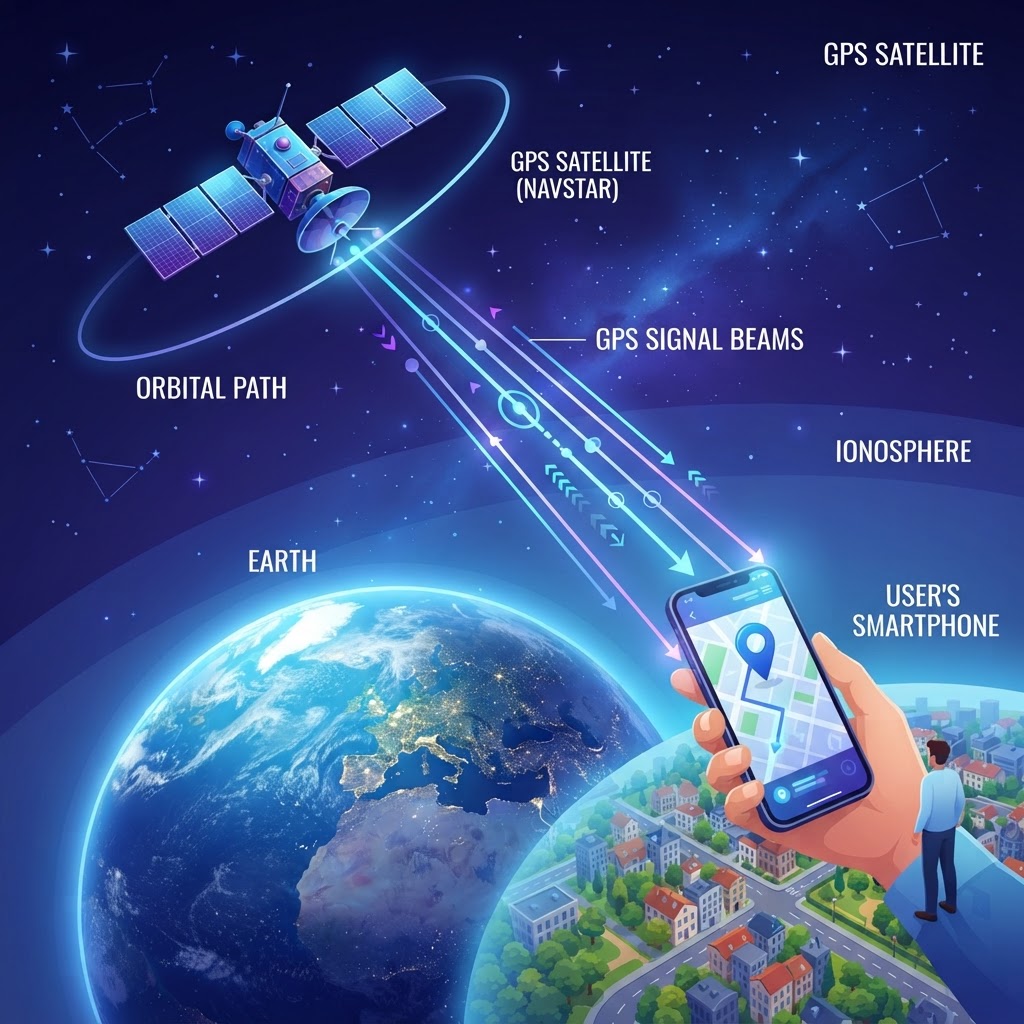
A smartphone functions as a sophisticated portable computer that translates your physical touch into complex electromagnetic signals, which are then transmitted across a global network to reach their destination. When you tap your screen, you are essentially initiating a high-speed chain reaction involving hardware sensors, microprocessors, and radio waves. This device seamlessly bridges the gap between your intent and the digital infrastructure of the world, relying on intricate engineering to maintain connectivity. From the moment your finger contacts the capacitive layer to the instant your data reaches a satellite or cell tower, millions of calculations occur in milliseconds to display the response on your liquid-crystal-display or OLED panel.
For kids: Your phone is like a tiny, super-fast wizard that turns your finger taps into invisible light signals, sends them zipping through the air to a giant tower, and brings back a message in the blink of an eye.
1. What It Is
At its core, a smartphone is a convergence device that integrates a transceiver, a central processing unit (CPU), and various input-output-systems into a compact chassis. It acts as a bidirectional communication hub that can simultaneously process audio, visual data, and network traffic while managing power efficiency. Modern smartphones are architectural marvels that house billions of transistors on a single silicon chip, enabling multitasking capabilities that rival desktop computers from a decade ago. These components work in unison to provide users with an interface that feels intuitive despite the underlying complexity of the electronic operations taking place.
2. How It Works
When you interact with the screen, the capacitive touch sensors detect the electrical conductivity of your finger, which changes the local electrostatic field. The digitizer then sends a precise coordinate to the application processor, often powered by an architecture like the Apple A-series or Qualcomm Snapdragon, which execute instructions at speeds exceeding 3 gigahertz. According to the GSM Association, the signal conversion process involves transforming your digital request into binary packets that are encoded onto radio frequency waves. For example, when you place a voice call via a provider like Verizon, the phone utilizes an Orthogonal Frequency Division Multiplexing (OFDM) process to break data into smaller sub-channels. This allows the signal to travel to the nearest cellular base station, which connects to the public-switched-telephone-network and eventually hits the recipient's local infrastructure. A notable real-world study by the IEEE Communications Society illustrates that this latency is often kept under 50 milliseconds to ensure a seamless human experience.
3. Why It Matters
Understanding how a phone functions is critical for appreciating the global digital-divide and the sheer scale of the infrastructure required to sustain our modern lifestyle. Without the miniaturization of semiconductors and the rapid development of low-latency wireless protocols, the democratization of information would not be possible in its current form. These devices serve as the primary window to the internet for billions of people, acting as tools for education, emergency services, and economic development. By grasping the mechanics of signal transmission and data processing, we can better understand how to protect our privacy and optimize the devices that define our daily productivity.
| Feature | Mobile Network (Cellular) | Wireless Network (Wi-Fi) | | :--- | :--- | :--- | | Range | Miles per tower | 100-300 feet per router | | Data Costs | Usually metered by provider | Often flat-rate or unlimited | | Handover | Seamless movement between cells | Limited to specific local range | | Security | Encrypted SIM-based access | Depends on router encryption |
4. In Summary
A phone functions by translating physical gestures into binary code that is transmitted as radio waves across a vast network of towers and servers. By coordinating between complex internal microprocessors and global infrastructure, it enables real-time communication and information retrieval for users worldwide.
5. Further Reading
- https://en.wikipedia.org/wiki/Smartphone
- https://en.wikipedia.org/wiki/Mobile_phone
- https://www.nasa.gov/general/how-satellites-communicate-with-earth/
- https://www.nature.com/subjects/telecommunications
Common Misconceptions
Your phone listens to your conversations to serve ads.
Phones use sophisticated predictive algorithms based on your browsing history and location data rather than recording voice audio.
Closing background apps saves significant battery life.
Modern operating systems like iOS and Android are designed to manage memory efficiently, and closing apps often forces a more power-intensive restart later.
Frequently Asked Questions
Do phones use Wi-Fi and Cellular data the same way?
No, Wi-Fi connects to a local router through broadband, while cellular data connects to a network of antennas provided by a telecommunications carrier.
What is the role of a CPU in a phone?
The Central Processing Unit acts as the brain, executing instructions from software to perform calculations and manage hardware components.
Does signal strength affect battery life?
Yes, when signal strength is low, the phone increases the power output of its radio to maintain a connection, which drains the battery faster.
Are smartphone screens actual liquid?
LCD stands for Liquid Crystal Display; the pixels contain a substance that acts like a liquid while maintaining the crystalline structure needed to manipulate light.
Key Terms
- Capacitive Touchscreen
- A display technology that detects touch by sensing the electrical disruption caused by a human finger.
- Radio Frequency
- An electromagnetic wave frequency used for wireless communication between a phone and a network tower.
- Binary Code
- A system of representing data using only two digits, 0 and 1, which acts as the foundation for digital computing.
Written by
Priya Sharma
AI & Technology Editor
Priya Sharma is the AI & Technology Editor at ExplainItSimple.AI. She holds a BSc in Computer Science from IIT Delhi and has worked as a machine learning engineer before moving to science communication. She specializes in making AI, software, and emerging tech understandable without a CS degree.
BSc Computer Science, IIT Delhi
View full profile📖 Get AI explanations on related topics:
Explore Smartphone at every level
Get a Smartphone explanation tailored for Kid, Teen, and Expert levels — with cited sources and follow-up quizzes.
Explain Smartphone for me