Understanding Research Papers: A Guide for Beginners (2026)
In brief
Research papers are scholarly documents detailing original scientific investigations, often dense with technical jargon and complex data structures.
Key Takeaways
- 1.Most academic papers follow the IMRaD format (Introduction, Methods, Results, and Discussion).
- 2.Abstracts provide a concise summary that highlights the study's objective and core findings.
- 3.Critical analysis involves checking the sample size, methodology, and limitations of the study.
Think of it like this
Reading an academic research paper without a map is like trying to navigate a dense, unmapped jungle with only a compass and no trail.
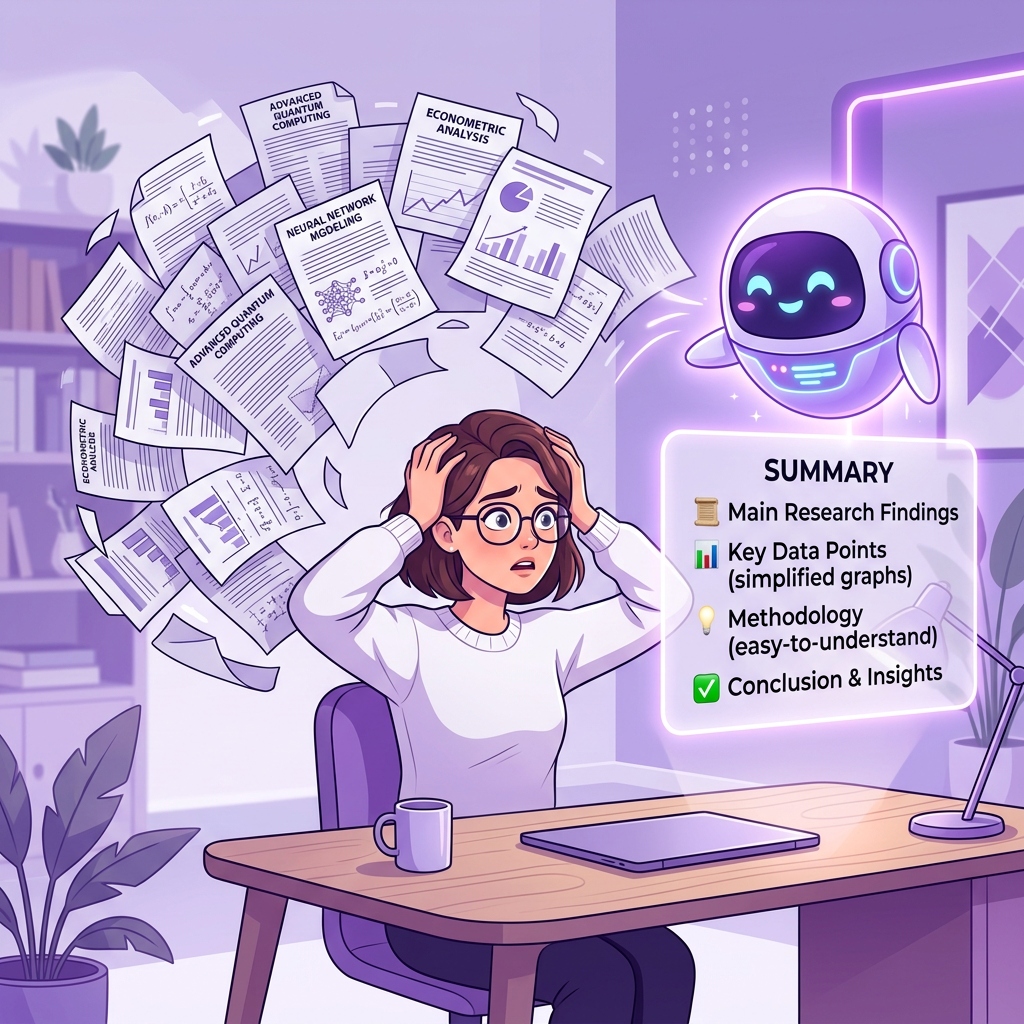
Understanding research papers allows you to access the cutting edge of human knowledge, even if you do not have a PhD in a specialized field. By breaking down complex academic writing into systematic steps, you can decipher the core findings of even the most dense scientific literature. Start by focusing on the abstract, then move to the conclusion before attempting to digest the full methodology. Using this strategy, you bypass the initial intimidation factor and immediately ground yourself in the primary arguments being presented. Whether you are a student, an inquisitive professional, or simply a lifelong learner, learning to read these documents is a high-value skill that pays dividends in understanding the world. For kids: Reading a research paper is just like being a detective; you look for the main clue first, check how the scientists found it, and then see why it changes what we know. ## 1. What It Is A research paper is a formal document published in an academic journal that presents the results of an original study or investigation. These papers are categorized as primary sources because they communicate the findings directly from the authors who conducted the work. They are subject to a rigorous process known as peer review, where other experts in the same field scrutinize the study to ensure its methodologies are sound and its conclusions are valid. The structure is typically standardized, featuring an abstract, introduction, literature review, methodology, results, discussion, and references, ensuring a consistent framework for reporting scientific methodology. Each section serves a distinct purpose, guiding the reader from the motivation behind the study to the final implications of the data discovered. ## 2. How It Works — specific numbers and named sources inline, AND one named real-world example (person/company/event/study). The process of reading a paper effectively involves a recursive approach that emphasizes data over prose. According to the "Three-Pass Approach" popularized by S. Keshav at the University of Waterloo, the first pass provides a bird's-eye view, the second pass captures the major content, and the third pass allows for deep reconstruction of the study's logic. When analyzing results, look for statistical significance, often indicated by a p-value of less than 0.05, which suggests the findings are unlikely due to random chance. For example, consider the seminal 2019 study published in the journal Nature by researchers from Google AI Quantum, which demonstrated "quantum supremacy." They utilized their Sycamore processor to solve a calculation in 200 seconds that would take the world’s most powerful supercomputer approximately 10,000 years to complete. By focusing on the specific variables and the experimental design used in that study, you can determine how the scientists reached their conclusion regarding computational advantage. This approach transforms a dense wall of text into a traceable map of evidence. ## 3. Why It Matters Understanding these documents matters because it empowers you to differentiate between credible information and anecdotal hype. In an era of rapid information dissemination, being able to verify the claims made in media reports against the original empirical evidence is an essential form of intellectual self-defense. It allows you to participate in informed debates, make evidence-based decisions about your health, technology, or finance, and keep pace with rapid technological shifts. Reading primary literature provides clarity that secondary news summaries often omit, particularly regarding the limitations or potential biases of a study. | Feature | Research Paper | News Article | | :--- | :--- | :--- | | Target Audience | Peers/Experts | General Public | | Tone | Formal/Technical | Accessible/Narrative | | Peer Review | Required | Optional | | Focus | Methodology/Data | Impact/Human Interest | ## 4. In Summary Mastering the skill of reading research papers involves systematically navigating the standardized structure to extract key data points and conclusions. By applying a tiered reading approach, you can effectively separate the core findings from complex technical jargon to gain reliable knowledge. ## 5. Further Reading https://en.wikipedia.org/wiki/Academic_publishing https://www.nature.com/articles/s41586-019-1666-5 https://www.ncbi.nlm.nih.gov/pmc/articles/PMC3474301/ https://www.nsf.gov/news/special_reports/science_nation/
Common Misconceptions
If a study is published in a journal, it is automatically 100% true.
Peer review checks for quality and methodology, but it does not guarantee the findings are infallible or free from bias.
You need a PhD to grasp the main point of a scientific paper.
By focusing on the Abstract, Conclusion, and visuals, non-experts can understand the implications of the research.
Frequently Asked Questions
What is the most important part of a paper?
The Abstract provides the big picture, while the Discussion section explains what the results actually mean.
Should I read a paper from start to finish?
No; most researchers read the Abstract, then the Conclusion, then scan the Figures, and only read the Methods if they need specific details.
What is peer review?
It is a process where other independent experts evaluate a paper for scientific rigor before it is published.
Are all research papers open access?
Not necessarily; many are behind paywalls, but sites like PubMed or Google Scholar often link to free, preprint versions.
Key Terms
- Abstract
- A short summary at the start of a research paper that explains the study's purpose and key results.
- Peer Review
- A quality control process where experts evaluate a study's validity before publication.
- Methodology
- The specific set of procedures and tools used by researchers to collect and analyze data.
📖 Get AI explanations on related topics:
Explore Research Paper at every level
Get a Research Paper explanation tailored for Kid, Teen, and Expert levels — with cited sources and follow-up quizzes.
Explain Research Paper for me