How the World Works: Simple Science Explanations for Curious Minds (2026)
In brief
From GPS satellites to volcano eruptions, discover simple science explanations for 8 of life's biggest questions about how our world works.
Table of Contents
- 🛰️ How GPS Works
- 🌊 Why the Ocean Is Salty
- 🌡️ How Scientists Know Climate Change Is Caused by Humans
- ⚡ How Electric Cars Work
- 🌿 Why Leaves Are Green
- 🌋 Why Volcanoes Erupt
- 🦑 What Lives at the Bottom of the Ocean
- 🌍 How the Earth Was Made
- 📊 Science Topics at a Glance
- 🔬 Why Understanding Science Matters
- 🚀 Ready to Explore More?
How the World Works: Simple Science Explanations for Curious Minds (2026)
Curiosity is one of the most powerful forces in the universe — and it costs nothing. Every time you look up at the sky, taste the sea, or wonder why your phone knows exactly where you are, you're brushing up against centuries of scientific discovery. The good news? You don't need a PhD to understand how the world works. You just need the right explanation. Let's dive in.
🛰️ How GPS Works
Your phone always knows where you are — but how? GPS (Global Positioning System) relies on a network of at least 24 satellites orbiting Earth about 20,000 km above the surface. Each satellite constantly broadcasts a signal that includes the exact time it was sent.
Your phone receives signals from at least four satellites and calculates how long each signal took to arrive. Since signals travel at the speed of light, tiny time differences reveal tiny distance differences — and by triangulating those distances, your device pinpoints your location to within a few metres.
Think of it like this: imagine three friends calling you from different parts of a city. Based on how long it takes each voice to reach you, you could estimate exactly where you're standing. GPS does the same thing, just with satellites and the speed of light. Modern GPS is so precise it even has to account for Einstein's theory of relativity — satellites in orbit experience time very slightly differently than we do on the ground.
🌊 Why the Ocean Is Salty
The ocean has been collecting salt for billions of years — and it's not stopping anytime soon. When rain falls, it picks up tiny amounts of carbon dioxide from the atmosphere, forming a weak carbonic acid. This slightly acidic rain erodes rocks on land, dissolving minerals including sodium and chloride — the two components of table salt.
Rivers carry these dissolved minerals into the ocean. While water evaporates from the ocean surface and returns to the sky as fresh water, the salt stays behind. Over millions of years, this process has steadily concentrated the ocean's saltiness to about 3.5% salinity.
Volcanic activity on the seafloor also contributes, releasing chloride and other minerals directly into the water. Think of the ocean as a giant bathtub that's been collecting mineral residue for 3.8 billion years — with no drain to let the salt out. The Dead Sea is an extreme example: it's landlocked, evaporation is intense, and salinity reaches nearly 34%, making it nearly impossible to sink in it.
🌡️ How Scientists Know Climate Change Is Caused by Humans
Scientists don't just guess — they have multiple independent lines of evidence pointing to human activity as the primary driver of modern climate change. First, direct measurements show CO₂ levels have risen from about 280 ppm before the Industrial Revolution to over 420 ppm today — tracking almost perfectly with industrialisation.
Second, isotopic analysis of atmospheric carbon is a game-changer. Carbon from burning fossil fuels has a distinct chemical fingerprint (lower levels of carbon-13 and carbon-14) compared to natural carbon. The rising CO₂ in our atmosphere carries that exact fossil fuel fingerprint.
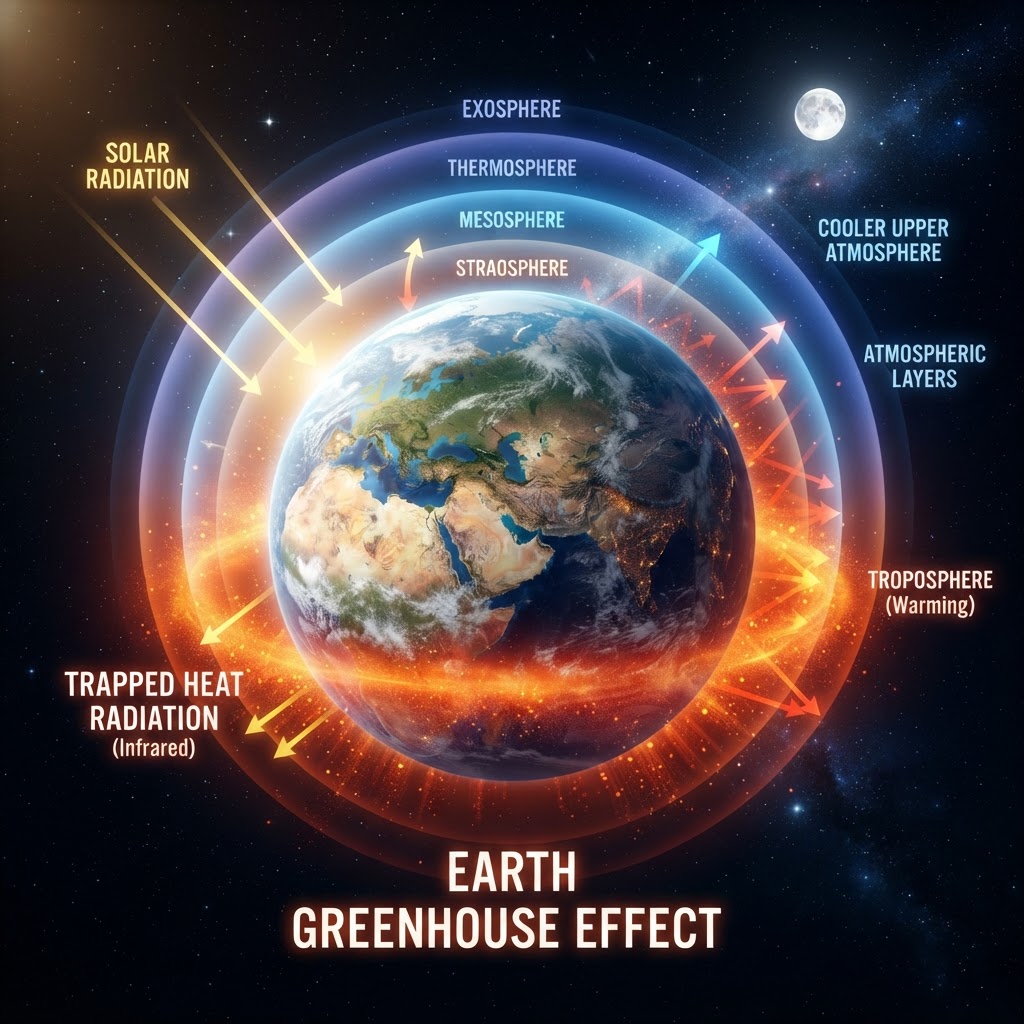
Third, the pattern of warming matches greenhouse gas physics: the lower atmosphere is warming while the upper atmosphere cools — exactly what greenhouse warming predicts, not what solar warming would cause. Think of it like a blanket: greenhouse gases trap heat close to Earth's surface. Multiple independent datasets from ice cores, ocean sensors, satellites, and weather stations all converge on the same conclusion. The science isn't just strong — it's overwhelming.
⚡ How Electric Cars Work
Electric cars replace the internal combustion engine with an electric motor powered by a large battery pack — usually lithium-ion, the same technology in your smartphone, just much bigger. When you press the accelerator, electricity flows from the battery to the motor, which converts electrical energy into rotational energy to spin the wheels.
One of the cleverest features of electric vehicles (EVs) is regenerative braking. When you slow down, the motor works in reverse — acting as a generator — converting kinetic energy back into electricity and storing it in the battery. This is why EVs are especially efficient in city driving with lots of stop-and-start traffic.
Think of it like a rechargeable toy car, scaled up enormously. With no exhaust pipe, no oil changes, and far fewer moving parts than a petrol engine, EVs are simpler to maintain and produce zero direct emissions. Modern EVs like those from Tesla, Rivian, and major legacy automakers can travel 300–500 km on a single charge, with fast chargers capable of replenishing 80% of the battery in under 30 minutes.
🌿 Why Leaves Are Green
Leaves are green because of chlorophyll — the pigment that plants use to capture sunlight for photosynthesis. But here's the twist: leaves aren't green because they absorb green light. They're green because they reflect it.
Chlorophyll is extraordinarily good at absorbing red and blue wavelengths of light, using that energy to convert carbon dioxide and water into glucose and oxygen. Green light, however, is largely reflected back — and that's the colour our eyes see.
Think of it like a picky eater: the plant gobbles up red and blue light and tosses the green back at you. In autumn, as daylight shortens and temperatures drop, trees stop producing chlorophyll. As the green fades, other pigments — yellows, oranges, and reds — that were always present but masked by chlorophyll are finally revealed. Some trees also produce new red pigments called anthocyanins as they prepare to shed their leaves, which is why autumn foliage can be so spectacularly colourful.
🌋 Why Volcanoes Erupt
Deep inside the Earth, the intense heat and pressure melt rock into magma — a superhot mixture of molten rock, gases, and minerals. Volcanoes form where this magma finds a pathway to the surface, most commonly at tectonic plate boundaries or above geological hotspots like Hawaii.
Magma is less dense than the solid rock around it, so it slowly rises — like a bubble in a lava lamp. As it approaches the surface, pressure drops, and dissolved gases (mainly water vapour, carbon dioxide, and sulphur dioxide) rapidly expand — much like a shaken fizzy drink exploding when you open it. This rapid gas expansion is what drives explosive eruptions.
Not all eruptions are explosive. If the magma is low in silica and gases, it flows relatively gently as lava. High-silica, gas-rich magma creates the violent, ash-filled eruptions like Mount St. Helens in 1980 or Pinatubo in 1991. Volcanoes are both destructive and creative — they've been building islands, enriching soils, and shaping Earth's atmosphere for billions of years.
🦑 What Lives at the Bottom of the Ocean
The deep ocean — below 1,000 metres — is one of the most extreme environments on Earth: pitch black, near-freezing, and under crushing pressures hundreds of times greater than at the surface. Yet life there is astonishingly abundant and bizarre.
Hydrothermal vents on the ocean floor spew superheated, mineral-rich water and support entire ecosystems that don't depend on sunlight at all. Instead of photosynthesis, bacteria here use chemosynthesis — converting chemicals like hydrogen sulphide into energy. These bacteria form the base of food chains that include giant tube worms up to 2 metres long, ghostly white crabs, and unique species of clams and shrimp.
The Mariana Trench — the deepest point on Earth at nearly 11 km — harbours snailfish, sea cucumbers, and single-celled organisms called foraminifera. Bioluminescence is common in the deep sea, where creatures produce their own light to attract prey, communicate, or confuse predators. Scientists estimate we've explored less than 20% of the ocean floor — meaning the deep sea likely holds thousands of species still unknown to science.
🌍 How the Earth Was Made
About 4.6 billion years ago, a vast cloud of gas and dust — a solar nebula — began to collapse under its own gravity. Most of the material fell inward to form the Sun, but a disc of leftover material continued orbiting. Within this disc, tiny particles collided and clumped together in a process called accretion, gradually building up pebbles, then boulders, then planetesimals, and eventually proto-planets.
Earth formed from this accumulation over tens of millions of years. In its early life, it was a molten, hellish world bombarded by asteroids and debris. A Mars-sized body called Theia is thought to have smashed into early Earth in a giant impact — blasting debris into orbit that eventually coalesced into the Moon.
As Earth cooled, heavier elements like iron and nickel sank to form the core, while lighter silicate rocks rose to form the mantle and crust. Volcanic outgassing released water vapour and other gases, eventually forming the oceans and a primitive atmosphere. Life appeared surprisingly quickly after — perhaps as early as 3.8 billion years ago. Think of Earth as a sculpture 4.6 billion years in the making, still being shaped today.
📊 Science Topics at a Glance
| Topic | Core Concept | Key Analogy | |---|---|---| | GPS | Satellite triangulation using signal timing | Friends calling from different city locations | | Salty Ocean | Mineral accumulation over billions of years | A bathtub with no salt drain | | Human Climate Change | Isotopic fingerprinting + atmospheric physics | A thickening heat-trapping blanket | | Electric Cars | Battery-powered motor with regenerative braking | A giant rechargeable toy car | | Green Leaves | Chlorophyll reflects green, absorbs red and blue | A picky eater who tosses back green | | Volcano Eruptions | Magma pressure + dissolved gases expanding | A shaken fizzy drink being opened | | Deep Sea Life | Chemosynthesis ecosystems under extreme pressure | A sunless alien world on Earth | | Earth's Formation | Accretion from a solar nebula over millions of years | A 4.6-billion-year sculpture |
🔬 Why Understanding Science Matters
Science isn't just a subject you study in school — it's the lens through which we understand reality. Knowing how GPS works helps you appreciate the engineering behind everyday conveniences. Understanding climate science empowers you to evaluate news and policy. Recognising how life thrives in the harshest places on Earth inspires hope that life might exist elsewhere in the universe.
The world is endlessly fascinating, and every answer unlocks new questions. Science literacy doesn't require memorising formulas — it requires curiosity and the willingness to ask why. In a world flooded with misinformation, understanding how things actually work is one of the most valuable skills you can have.
The eight topics in this article are just the beginning. There are millions of questions worth asking — about black holes, the human brain, the chemistry of cooking, or the mathematics of music. Every single one has a beautiful, comprehensible answer waiting to be discovered.
🚀 Ready to Explore More?
If you loved these explanations, ExplainItSimple.AI was built for you. Ask any science question — no matter how big or small — and get a clear, jargon-free answer in seconds. Whether you're a student, a teacher, a curious parent, or a lifelong learner, our AI makes complex topics genuinely accessible.
👉 Try ExplainItSimple.AI today — because every question deserves a great answer.
📖 Get AI explanations on related topics:
Explore nature at every level
Get a nature explanation tailored for Kid, Teen, and Expert levels — with cited sources and follow-up quizzes.
Explain nature for me