
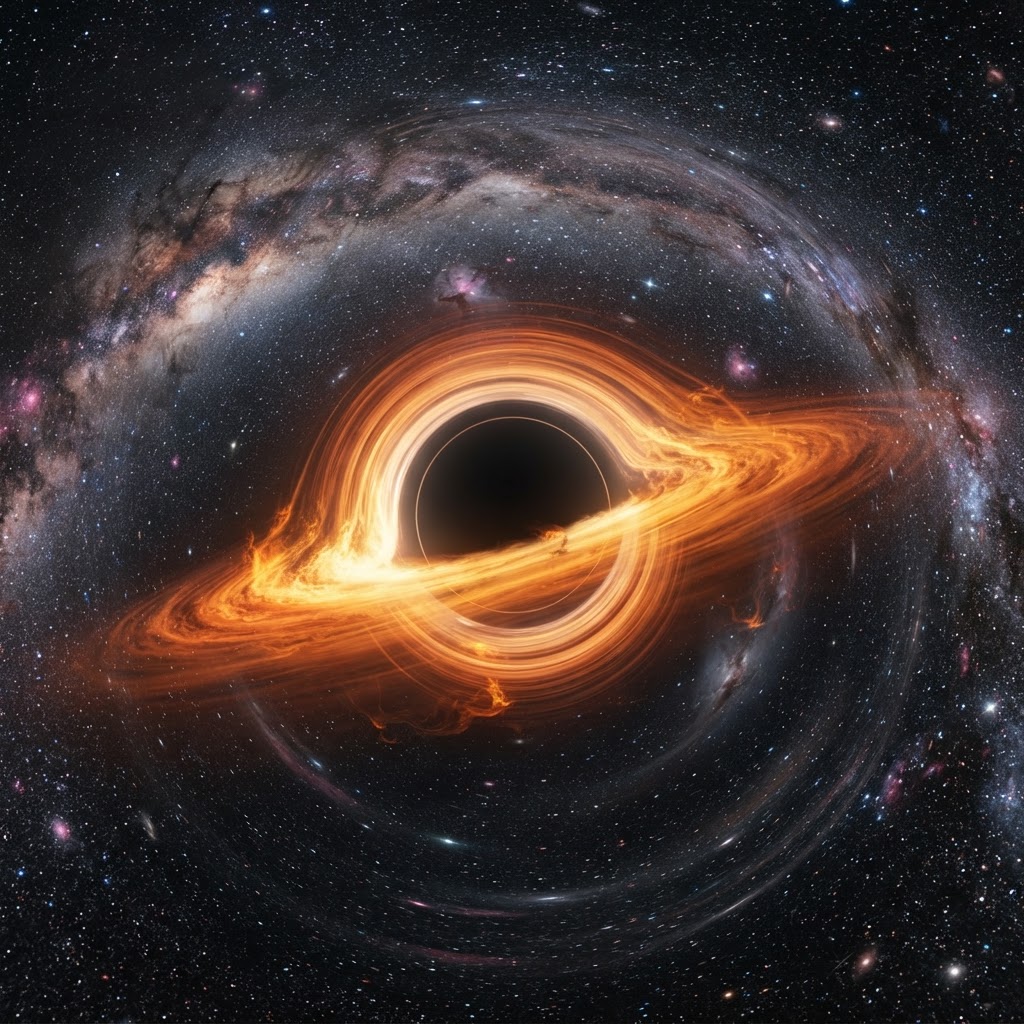
What Are Black Holes? (2026)
In brief
A black hole is an astronomical object with a gravitational field so intense that no matter or electromagnetic radiation can escape its vicinity.
Key Takeaways
- 1.Black holes are not empty voids but are objects with massive amounts of matter packed into an incredibly small space.
- 2.The event horizon acts as a theoretical boundary of no return from which even light cannot escape.
- 3.Black holes eventually lose mass through a slow process of evaporation known as Hawking radiation.
Think of it like this
Think of a black hole like a bottomless, one-way trapdoor in space where the gravity is so steep that even if you traveled at the speed of light, you would only be pulled deeper into the center.
Table of Contents
Black holes are regions of spacetime exhibiting gravitational acceleration so strong that nothing, including electromagnetic radiation like light, can escape from them. According to Albert Einstein’s general theory of relativity, a sufficiently compact mass can deform spacetime to form a black hole. At the center of a black hole lies a gravitational singularity, a point of infinite density where the known laws of physics cease to function as we understand them. These cosmic phenomena remain one of the most enigmatic subjects in modern astrophysics, acting as gravitational anchors that challenge our comprehension of the universe's fabric, evolution, and ultimate destiny. By studying how event horizons swallow surrounding matter, scientists gain deeper insights into the fundamental nature of space, time, and gravity.
For kids: A black hole is like a giant, invisible vacuum cleaner in space with gravity so strong that not even light can zoom away from it.
1. What It Is
A black hole is essentially a vast amount of matter packed into a very small area, creating an incredibly intense gravitational pull. When a massive star reaches the end of its life cycle and exhausts its nuclear fuel, it undergoes a dramatic gravitational collapse that can result in the formation of a stellar-mass black hole. The boundary surrounding this core is known as the event horizon, which serves as the point of no return for any object, particle, or photon. Once something crosses this threshold, the curvature of spacetime becomes so steep that all paths lead inward toward the singularity, making escape mathematically impossible under standard physical models.
2. How It Works — specific numbers and named sources inline, AND one named real-world example
The mechanics of black holes are dictated by the relationship between mass, radius, and gravity. According to the Schwarzschild radius formula, an object's radius must shrink to a specific size to become a black hole; for example, if the Sun were compressed into a sphere with a radius of only 3 kilometers, it would become a black hole with the same mass. NASA data confirms that stellar-mass black holes typically range from 5 to 30 times the mass of our Sun, while supermassive black holes at the centers of galaxies can reach millions or billions of solar masses. A landmark real-world example occurred in 2019, when the Event Horizon Telescope collaboration captured the first-ever direct image of the shadow of the supermassive black hole at the center of the M87 galaxy. This black hole, estimated to be 6.5 billion times the mass of the Sun, provided empirical evidence that the predictions made by general-relativity regarding the appearance of light near a horizon are accurate to within precise mathematical tolerances.
3. Why It Matters
Understanding black holes is vital because they serve as the ultimate laboratories for testing the limits of physics. They are the only places in the universe where general relativity and quantum mechanics—the two pillars of modern science—must be reconciled, yet currently refuse to play by the same rules. Furthermore, supermassive black holes play a critical role in galaxy formation and the regulation of star-forming rates across the cosmos. By observing how accretion-disks radiate energy before matter falls into the abyss, researchers can determine the age, composition, and expansion rate of the distant universe. Their existence proves that gravity is not merely a force, but a dynamic geometry that shapes the very history of our existence.
| Feature | Stellar-Mass Black Hole | Supermassive Black Hole | | :--- | :--- | :--- | | Typical Mass | 5-30 Solar Masses | Millions-Billions Solar Masses | | Location | Scattered throughout galaxy | Centers of most large galaxies | | Formation | Collapsed massive stars | Mergers and accretion over eons | | Discovery Method | X-ray binaries / Gravitational waves | Orbital motion of stars / Imaging |
4. In Summary — 2-3 sentence recap.
Black holes are extreme gravitational sinks created by the collapse of massive stellar structures that permanently trap everything entering their event horizon. They represent the ultimate intersection of gravity and spacetime, providing scientists with essential clues about the origins and eventual expansion of our universe.
5. Further Reading — 3-5 external authoritative links
https://en.wikipedia.org/wiki/Black_hole https://www.nasa.gov/black-holes https://science.nasa.gov/universe/black-holes https://www.nature.com/subjects/black-holes
Common Misconceptions
Black holes are cosmic vacuum cleaners that suck up everything in the universe.
Black holes only exert a powerful gravitational pull on objects that cross their event horizon; otherwise, they act like any other massive object in space.
A black hole is a literal hole or a tunnel in the fabric of space.
It is actually an extremely dense concentration of matter, not an empty space or a doorway to another dimension.
Frequently Asked Questions
Can a black hole suck up the entire universe?
No, black holes do not wander the universe sucking objects up like vacuum cleaners; they only affect things that get dangerously close to their gravitational pull.
What happens if you fall into a black hole?
You would experience spaghettification, where extreme tidal forces stretch your body into thin strands due to the difference in gravity between your feet and head.
Are all stars destined to become black holes?
No, only the most massive stars, typically those at least 20 times the mass of our Sun, have enough gravity to collapse into a black hole.
Can we see black holes directly?
Black holes themselves are invisible, but scientists can observe their impact on surrounding light and matter, such as the 2019 image of the M87* shadow.
Does time stop near a black hole?
Time dilation occurs, meaning time for an observer falling into a black hole would appear to slow down significantly compared to an outside observer.
Key Terms
- Singularity
- A point at the center of a black hole where matter is crushed to infinite density.
- Event Horizon
- The boundary surrounding a black hole beyond which nothing, not even light, can escape.
- General Relativity
- Albert Einstein's theory describing gravity as the curvature of spacetime caused by mass and energy.
- Spaghettification
- The process where an object is stretched into long, thin shapes due to extreme tidal forces near a black hole.
📖 Get AI explanations on related topics:
Explore black holes at every level
Get a black holes explanation tailored for Kid, Teen, and Expert levels — with cited sources and follow-up quizzes.
Explain black holes for me