What Causes Climate Change? (2026)
In brief
Climate change is caused by the accumulation of greenhouse gases in the atmosphere, which trap heat and increase the Earth's surface temperature.
Key Takeaways
- 1.Carbon dioxide concentrations have increased by nearly 50% since the start of the Industrial Revolution.
- 2.The Intergovernmental Panel on Climate Change (IPCC) states that human influence is unequivocally the primary driver of observed warming since the mid-20th century.
- 3.Methane, while shorter-lived than CO2, has a global warming potential over 80 times greater than CO2 over a 20-year period.
Think of it like this
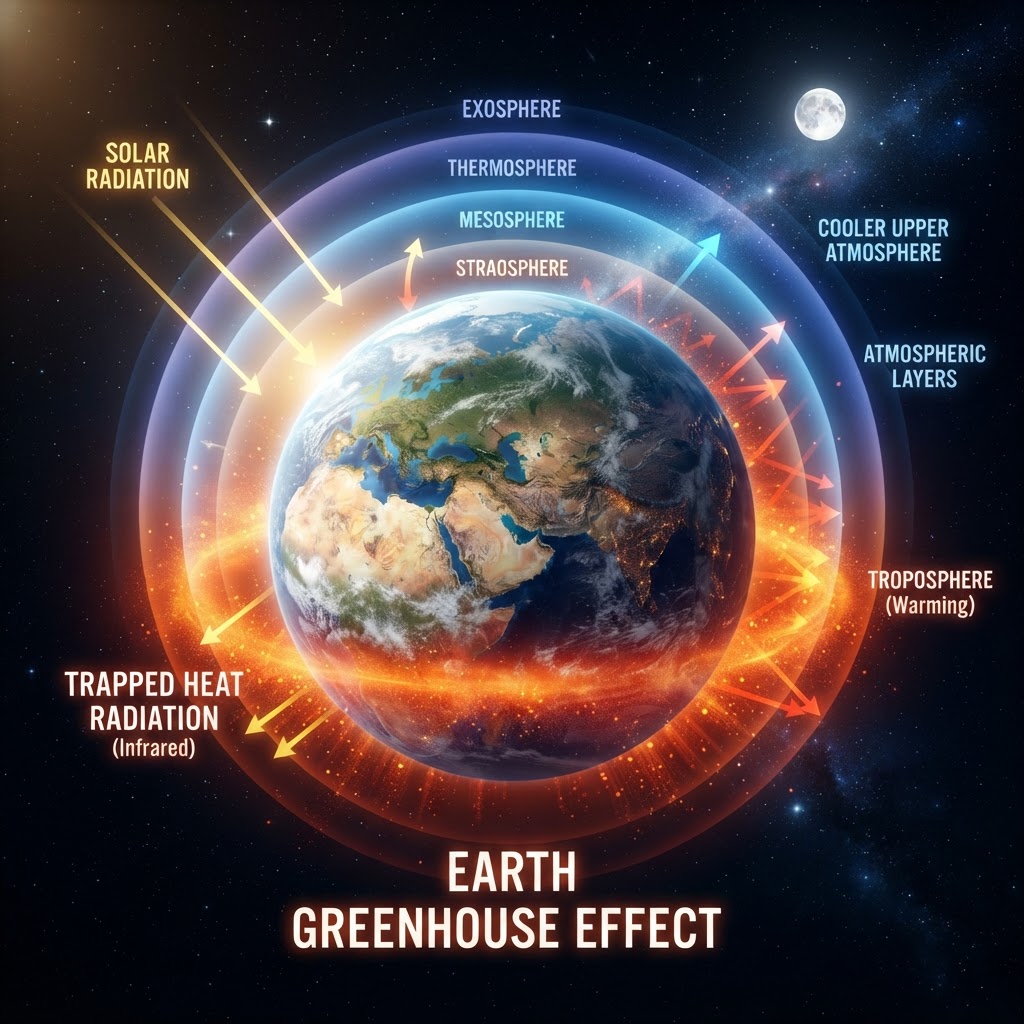
The greenhouse effect acts like a thick winter blanket wrapped around the Earth, preventing body heat from escaping into the cold night air.
Climate change is primarily driven by the excessive accumulation of greenhouse gases in Earth's atmosphere, which traps solar heat and triggers a rise in global temperatures. Human activities, particularly the burning of fossil fuels like coal, oil, and natural gas, have drastically increased carbon dioxide concentrations since the Industrial Revolution. This shift in the greenhouse-effect alters weather patterns, melts polar ice, and drives sea-level rise across the globe. By understanding the causal mechanisms behind these temperature shifts, we can better identify the necessary pathways to mitigate long-term ecological damage. Transitioning to sustainable energy-systems is the most critical step humanity can take to reverse these dangerous warming trends and protect future biodiversity. For kids: Climate change is like Earth wearing a sweater that is getting too thick, making the planet feel way too hot and causing the ice to melt. ## 1. What It Is Climate change refers to long-term shifts in temperatures and weather patterns on a planetary scale. While Earth has experienced natural fluctuations in climate throughout its multi-billion-year history, the current rate of warming is unprecedented in the modern era. These changes are largely defined by the rapid increase in atmospheric carbon dioxide, methane, and nitrous oxide. These gases act as a thermal blanket, preventing infrared radiation from escaping back into space. The result is a consistent warming of the oceans, landmasses, and the atmosphere. Scientists use the term global-warming to describe the specific rise in surface temperatures, which acts as the foundation for broader climate shifts. ## 2. How It Works The mechanics of climate change are rooted in the physical properties of greenhouse gases. According to the National Oceanic and Atmospheric Administration (NOAA), the concentration of carbon dioxide in our atmosphere has risen from approximately 280 parts per million in the pre-industrial era to over 420 parts per million today. This 50% increase directly correlates with higher global average temperatures, which have risen by roughly 1.1 degrees Celsius since the late 19th century. A primary real-world example is the melting of the Greenland Ice Sheet; NASA satellite data confirms that Greenland is losing an average of 279 billion tons of ice per year, directly contributing to measurable sea-level rise. This process is accelerated by the albedo effect, where melting ice exposes darker ocean water that absorbs more heat instead of reflecting it. Furthermore, deforestation prevents the natural carbon sequestration process, leaving more CO2 to circulate freely in the air. ## 3. Why It Matters Understanding why climate change matters is essential for predicting the impact on human civilization and natural ecosystems. Rising temperatures lead to more frequent and intense extreme weather events, such as heatwaves, prolonged droughts, and catastrophic flooding. These disruptions threaten agricultural productivity, creating food security risks for vulnerable populations globally. Additionally, ocean acidification—caused by the absorption of excess carbon dioxide—destroys coral reefs and threatens marine life that billions of people rely on for protein. Protecting our ecosystem-health is a matter of survival, as the stability of human societies depends on predictable climate patterns. | Component | Pre-Industrial Level | Current Level | Impact | | :--- | :--- | :--- | :--- | | Carbon Dioxide | ~280 ppm | ~420 ppm | Traps heat | | Methane | ~720 ppb | ~1900 ppb | Potent warming | | Surface Temp | 0 C (baseline) | +1.1 C | Climate instability | ## 4. In Summary Climate change is a direct consequence of increased greenhouse gas emissions from human industrial activities that trap heat within our atmosphere. Addressing this crisis requires a global reduction in carbon output and a transition toward cleaner, renewable technologies to restore the natural balance of Earth's climate. ## 5. Further Reading https://en.wikipedia.org/wiki/Climate_change https://climate.nasa.gov https://www.noaa.gov/climate https://www.nature.com/subjects/climate-change
Common Misconceptions
Climate change is caused solely by natural volcanic eruptions and solar cycles.
Natural factors have had a negligible net effect on climate trends since 1950, whereas human greenhouse gas emissions have caused significant, rapid warming.
Global warming means every location on Earth will experience the same temperature rise.
Climate change causes uneven regional warming, with the Arctic currently warming at more than twice the global average rate.
Frequently Asked Questions
What is the primary greenhouse gas?
Carbon dioxide (CO2) is the primary driver of climate change due to the massive volume released by human activity.
Are there natural causes of climate change?
Yes, natural factors include solar irradiance, volcanic activity, and orbital changes, but they are not the primary cause of current warming.
Does the ozone hole cause climate change?
No, the ozone hole and climate change are separate issues, though some ozone-depleting substances are also potent greenhouse gases.
What is radiative forcing?
Radiative forcing is a measure of the influence that a factor has on the energy balance of the Earth-atmosphere system.
Can we reverse climate change?
While we cannot quickly reverse the warming already caused, rapid decarbonization can prevent the most severe future scenarios.
Key Terms
- Greenhouse Effect
- The process by which certain gases in the atmosphere trap heat, preventing it from escaping into space.
- Radiative Forcing
- The difference between incoming solar radiation absorbed by the Earth and energy radiated back into space.
- Fossil Fuels
- Carbon-rich energy sources like coal, oil, and natural gas formed from ancient organic matter.
📖 Get AI explanations on related topics:
Explore climate at every level
Get a climate explanation tailored for Kid, Teen, and Expert levels — with cited sources and follow-up quizzes.
Explain climate for me