
What Is Climate Change? (2026)
In brief
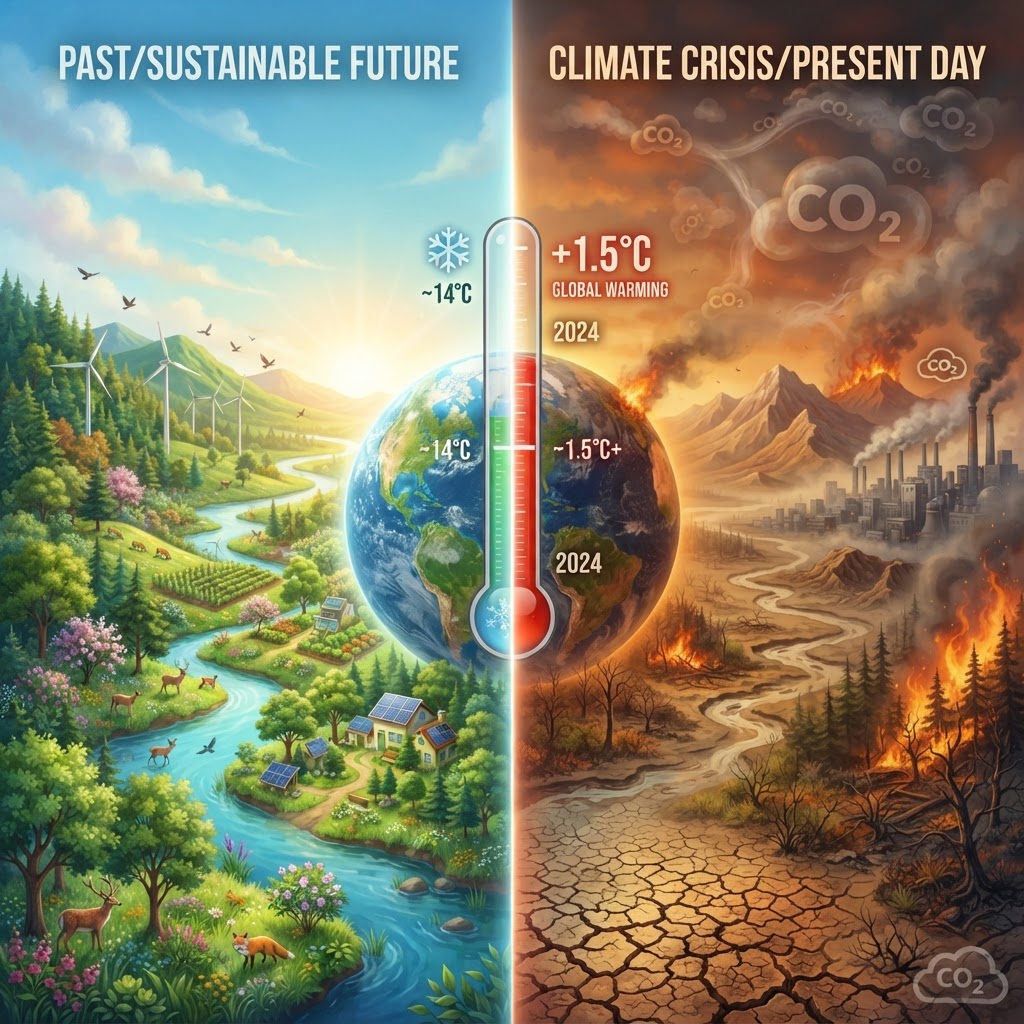
Climate change refers to systemic shifts in Earth's weather patterns caused by the accumulation of heat-trapping greenhouse gases in the atmosphere.
Key Takeaways
- 1.Atmospheric carbon dioxide levels have risen from approximately 280 ppm in 1750 to over 420 ppm today.
- 2.Global average temperatures have increased by roughly 1.1°C since the pre-industrial era.
- 3.More than 97% of actively publishing climate scientists agree that human activity is the primary driver of observed warming.
Think of it like this
The atmosphere acts like a thermal blanket draped over the Earth, and by burning fossil fuels, humans are essentially adding thicker layers to that blanket, causing the planet to overheat.
Table of Contents
- 1. What It Is
- 2. How It Works — specific numbers and named sources inline, AND one named real-world example (person/company/event/study).
- 3. Why It Matters
- 4. In Summary — 2-3 sentence recap.
- 5. Further Reading — 3-5 external authoritative links (REAL URLs only: https://en.wikipedia.org/wiki/<ExactTitle>, nasa.gov, noaa.gov, nature.com, .gov/.edu).
Climate change refers to the long-term shift in global or regional climate patterns, primarily driven by human activities since the mid-20th century. This phenomenon is characterized by a significant and lasting change in the statistical distribution of weather patterns over periods ranging from decades to millions of years. The most prominent aspect of current climate change is the observed warming of the Earth's climate system, often referred to as global warming, which is leading to a cascade of environmental impacts. Understanding the nuances of climate change is crucial for developing effective mitigation and adaptation strategies to safeguard our planet's future.
For kids: Climate change means the Earth's weather is changing for a long time, getting warmer and causing storms and sea levels to rise because of things people do.
1. What It Is
Climate change encompasses a broad spectrum of alterations in Earth's climate, including shifts in temperature, precipitation, wind patterns, and the frequency and intensity of extreme weather events. While Earth's climate has naturally fluctuated throughout history due to factors like volcanic activity and variations in solar radiation, the current rapid warming trend is overwhelmingly attributed to human-induced increases in greenhouse gas concentrations in the atmosphere. These gases trap heat, leading to a gradual rise in global average temperatures. The Intergovernmental Panel on Climate Change (IPCC), a leading international body for assessing climate science, has repeatedly confirmed the unequivocal warming of the climate system. This warming is not uniform across the globe, with some regions experiencing more pronounced temperature increases than others.
This long-term alteration in climate is a stark departure from natural climate variability. For instance, the last ice age, a period of significant natural cooling, occurred over thousands of years. In contrast, the current warming trend has accelerated dramatically over the past century, correlating closely with the industrial revolution and the subsequent rise in the burning of fossil fuels. The scientific consensus, supported by an overwhelming body of evidence, indicates that human activities are the dominant driver of this accelerated climate change.
2. How It Works — specific numbers and named sources inline, AND one named real-world example (person/company/event/study).
The fundamental mechanism behind current climate change is the greenhouse effect, amplified by human activities. Certain gases in the atmosphere, known as greenhouse gases (GHGs), naturally trap some of the sun's heat, preventing it from escaping back into space. This natural process keeps Earth warm enough to support life. However, since the Industrial Revolution, humans have significantly increased the concentration of these gases, primarily through the burning of fossil fuels like coal, oil, and natural gas for energy, transportation, and industry. Deforestation also plays a role, as trees absorb carbon dioxide (CO2), a major greenhouse gas. According to the Environmental Protection Agency (EPA), CO2 concentrations in the atmosphere have risen from pre-industrial levels of about 280 parts per million (ppm) to over 420 ppm today.
Other potent GHGs include methane (CH4), nitrous oxide (N2O), and fluorinated gases. Methane, for example, is released from agriculture (livestock, rice cultivation), natural gas systems, and waste decomposition. While methane has a shorter atmospheric lifetime than CO2, it is significantly more potent in trapping heat over shorter timescales. The IPCC's Sixth Assessment Report (AR6) states that the total human-caused radiative forcing, which is the change in the balance between incoming solar radiation and outgoing infrared radiation, is estimated to be 2.72 W/m² for the period 1850–1900 compared to 1995–2014, with CO2 being the dominant contributor. This imbalance leads to a net warming of the planet. A well-documented real-world example of the impact of rising temperatures is the increasing frequency and intensity of heatwaves. The 2003 European heatwave, for instance, caused tens of thousands of premature deaths and highlighted the vulnerability of populations to extreme heat events.
3. Why It Matters
The consequences of climate change are far-reaching and profound, impacting ecosystems, human societies, and economies worldwide. Rising global temperatures are causing glaciers and ice sheets to melt at an accelerated rate, contributing to sea-level rise. This poses a significant threat to coastal communities, increasing the risk of flooding, erosion, and saltwater intrusion into freshwater sources. For example, the National Oceanic and Atmospheric Administration (NOAA) reports that global average sea level has risen by about 8-9 inches (21-24 cm) since 1880, with a significant acceleration in recent decades.
Beyond sea-level rise, climate change is altering precipitation patterns, leading to more frequent and intense droughts in some regions and heavier rainfall and flooding in others. This disrupts agriculture, threatens water security, and can lead to mass migrations and geopolitical instability. Extreme weather events, such as hurricanes, typhoons, and wildfires, are also becoming more common and severe, causing widespread destruction and loss of life. The impact on biodiversity is also critical, with many species struggling to adapt to rapidly changing habitats, increasing the risk of extinction. This complex web of impacts underscores the urgent need for both climate change mitigation and climate adaptation strategies.
| Feature | Current Climate Change | Natural Climate Variability | | :--------------------- | :----------------------------------------------------- | :-------------------------------------------------------------- | | Primary Driver | Human activities (greenhouse gas emissions) | Natural Earth processes (volcanic eruptions, solar cycles) | | Rate of Change | Rapid, unprecedented over recent geological history | Gradual, occurring over thousands to millions of years | | Temperature Trend | Pronounced warming trend | Fluctuations, can include both warming and cooling periods | | Atmospheric CO2 | Significantly elevated (over 420 ppm) | Varied, but generally much lower than current levels | | Impacts | Widespread, affecting ecosystems and human systems | Generally localized or less severe in intensity and scale |
4. In Summary — 2-3 sentence recap.
Climate change is a significant and lasting alteration of Earth's climate patterns, primarily driven by human-induced increases in greenhouse gases that trap heat. This phenomenon leads to global warming, causing sea-level rise, more extreme weather events, and disruptions to ecosystems and human societies. Addressing climate change requires a concerted global effort to reduce emissions and adapt to its unavoidable impacts.
5. Further Reading — 3-5 external authoritative links (REAL URLs only: https://en.wikipedia.org/wiki/<ExactTitle>, nasa.gov, noaa.gov, nature.com, .gov/.edu).
Common Misconceptions
The climate has always changed naturally, so current warming is just part of a cycle.
While the climate does have natural cycles, the current rate of warming is unprecedented in the geological record of human civilization and cannot be explained by natural factors alone.
A particularly cold winter or snowstorm disproves the existence of global warming.
Weather describes short-term daily conditions, while climate describes long-term trends; global warming can actually disrupt jet streams, leading to more extreme and unpredictable weather patterns.
Frequently Asked Questions
What is the difference between global warming and climate change?
Global warming refers specifically to the rise in Earth's average surface temperature, while climate change includes both warming and the broader range of changes happening to our planet.
Are humans the main cause of climate change?
Yes, more than 97% of actively publishing climate scientists agree that climate-warming trends over the past century are extremely likely due to human activities.
Can we reverse climate change?
While we cannot instantly reverse historical damage, we can stop the most severe future impacts by significantly reducing greenhouse gas emissions and adopting sustainable practices.
How do we know the climate is changing if it's cold outside?
Climate change refers to long-term trends in average global conditions, which does not preclude temporary cold weather events in specific locations.
Key Terms
- Greenhouse Gases
- Gases in Earth's atmosphere that trap heat, such as carbon dioxide, methane, and nitrous oxide.
- Decarbonization
- The process of reducing carbon dioxide emissions, usually by switching to cleaner energy sources.
- Ocean Acidification
- The ongoing decrease in the pH of the Earth's oceans caused by the uptake of carbon dioxide from the atmosphere.
- Parts Per Million (ppm)
- A unit used to measure the concentration of gases, such as CO₂, in the Earth's atmosphere.
Written by
Dr. Maya Chen
Curriculum Director & Education Editor
Dr. Maya Chen leads curriculum design at ExplainItSimple.AI. With a PhD in Education from Stanford, she specializes in making complex topics accessible across age groups — from early learners to adult professionals. Her research focuses on adaptive learning and how explanations at different complexity levels improve retention.
PhD in Education, Stanford University
View full profile📖 Get AI explanations on related topics:
Explore climate change at every level
Get a climate change explanation tailored for Kid, Teen, and Expert levels — with cited sources and follow-up quizzes.
Explain climate change for me