Inflation: What It Is and Why Prices Rise (2026)
In brief
Inflation is the sustained increase in the general price level of goods and services in an economy, leading to a decrease in the purchasing power of money.
Key Takeaways
- 1.Inflation reduces the purchasing power of each unit of currency.
- 2.It is measured by the Consumer Price Index (CPI) in the United States.
- 3.Central banks, like the Federal Reserve, typically target a low, stable inflation rate.
Think of it like this
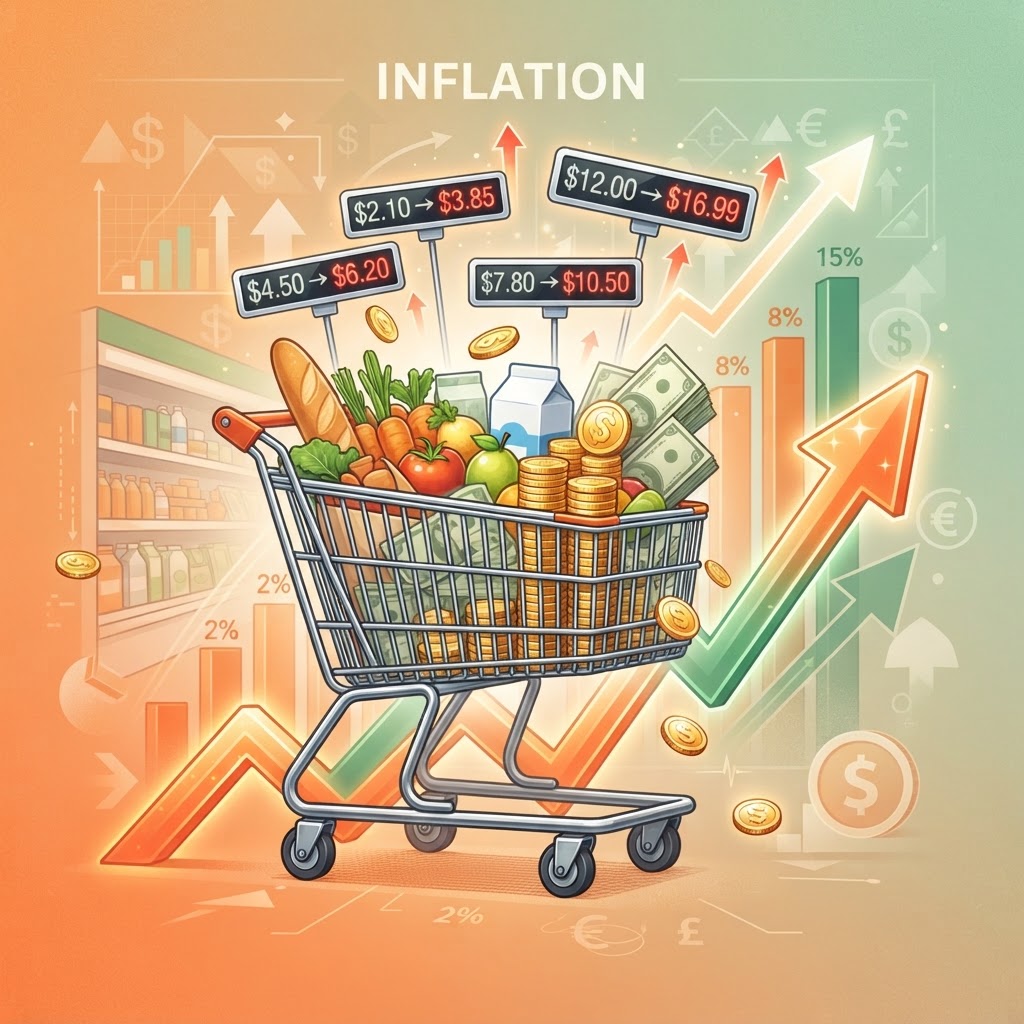
Inflation acts like a slow leak in a balloon that represents your money's value, requiring you to use more currency to buy the same size item over time.
Inflation refers to the steady increase in the general price level of goods and services within an economy over a specific period, effectively reducing the purchasing power of your money. When inflation occurs, each unit of currency buys fewer items than it did previously, meaning your household budget must stretch further to cover the same standard of living. This economic phenomenon is measured by tracking the average price change of a basket of consumer goods and services, such as transportation, food, and medical care. Understanding the mechanics behind price-stability and monetary policy is essential for navigating long-term financial planning and protecting your personal savings from erosion.
For kids: Inflation is like a magical shrinking machine for your piggy bank; it makes the toys and candy you want cost more money over time even though the coins inside your bank stay the exact same.
1. What It Is
At its core, inflation is a quantitative measure of the rate at which the average price level of a basket of selected goods and services in an economy increases. It represents a decline in the real value of a medium of exchange within the internal economy. Economists classify inflation into several categories, most notably demand-pull inflation, cost-push inflation, and built-in inflation. Demand-pull inflation occurs when the aggregate demand for goods exceeds the available supply, often described as too much money chasing too few goods. Conversely, cost-push inflation arises when the costs of production—such as raw materials or wages—increase significantly, forcing businesses to pass those costs onto the consumer to maintain their profit margins. This macroeconomic-indicator serves as a critical barometer for the health of a national economy, helping policymakers determine interest rate adjustments and fiscal strategies.
2. How It Works
The primary driver of inflation is often linked to the expansion of the money supply by central banks, such as the Federal Reserve, which manages the monetary-policy of the United States. According to the Bureau of Labor Statistics (BLS), the Consumer Price Index (CPI) serves as the standard metric for calculating inflation by comparing the costs of a weighted average of goods. For instance, if the CPI rose by 3.4% over a 12-month period ending in December 2026, it indicates that a typical basket of goods costing $100 last year would cost approximately $103.40 today. A real-world example of this occurred during the post-2026 pandemic recovery, where supply chain bottlenecks combined with stimulus-driven demand led to significant inflationary pressure. Companies like Ford and General Motors faced skyrocketing costs for semiconductor chips, which forced them to significantly increase the MSRP of their vehicles, demonstrating how supply-chain-logistics directly feed into retail price inflation.
3. Why It Matters
Inflation matters because it dictates the rhythm of the global economy and influences the standard of living for every citizen. If inflation rises faster than wages, the standard of living drops, as workers find themselves unable to afford the same necessities they purchased the year prior. It also creates uncertainty for businesses, which must navigate volatile input costs when setting long-term contracts or investment goals. Furthermore, savers are particularly vulnerable; if a bank account earns 0.5% interest while inflation is running at 3%, the actual value of the money in that account is losing 2.5% of its power annually. This reality forces investors to seek assets that traditionally hedge against inflation, such as real estate, commodities, or Treasury Inflation-Protected Securities (TIPS).
| Indicator | Impact of High Inflation | Impact of Deflation | | :--- | :--- | :--- | | Purchasing Power | Declines rapidly | Increases temporarily | | Consumer Behavior | Spend now before prices rise | Delay purchases expecting lower prices | | Debt Burden | Easier to pay back with devalued dollars | Harder to pay back as dollars grow stronger | | Economic Growth | Can lead to overheating | Often leads to stagnation |
4. In Summary
Inflation is a complex economic reality that reduces the purchasing power of money by driving up the general cost of living. By monitoring indices like the CPI, individuals and governments can adjust their financial behaviors and policies to mitigate the long-term impact on savings and growth.
5. Further Reading
- https://en.wikipedia.org/wiki/Inflation
- https://www.bls.gov/cpi/
- https://www.federalreserve.gov/monetarypolicy/monetary-policy-what-are-its-goals-how-does-it-work.htm
- https://www.imf.org/en/Publications/fandd/issues/Series/Back-to-Basics/Inflation
Common Misconceptions
Inflation is always caused by corporate greed.
Inflation is a complex macroeconomic phenomenon driven by supply and demand, money supply, and production costs.
High inflation is always bad for everyone.
While high inflation hurts savers, it can sometimes benefit debtors who repay loans with money that is worth less than when they borrowed it.
Frequently Asked Questions
What is the primary indicator of inflation?
The Consumer Price Index (CPI), published by the Bureau of Labor Statistics, is the primary measure.
Why do central banks want some inflation?
Low, predictable inflation encourages spending and investment instead of hoarding cash.
Does inflation mean every single item gets more expensive?
No, inflation measures the average price level, so some specific goods may get cheaper even while the overall index rises.
How can I protect my money from inflation?
People often invest in assets like stocks, real estate, or inflation-protected securities like TIPS to preserve value.
Key Terms
- Purchasing Power
- The financial ability to buy goods and services with a specific amount of money.
- Consumer Price Index
- A measure that examines the weighted average of prices of a basket of consumer goods and services.
- Deflation
- A general decline in prices for goods and services, often associated with a contraction in the supply of money.
📖 Get AI explanations on related topics:
Explore inflation at every level
Get a inflation explanation tailored for Kid, Teen, and Expert levels — with cited sources and follow-up quizzes.
Explain inflation for me