
What Is Quantum Computing? (2026)
In brief
Quantum computing leverages the principles of quantum mechanics, using qubits to solve highly complex problems faster than classical computers.
Key Takeaways
- 1.Quantum computers use qubits, which can exist in multiple states at once through a phenomenon known as superposition.
- 2.Entanglement allows qubits to be linked, enabling the computer to process complex correlations that are impossible for classical bits.
- 3.These systems are designed for specific, highly complex tasks like molecular simulation and cryptography rather than everyday consumer computing.
Think of it like this
While a classical computer is like a librarian searching for a book one shelf at a time, a quantum computer is like a librarian who can read every shelf in the building simultaneously to find the exact volume.
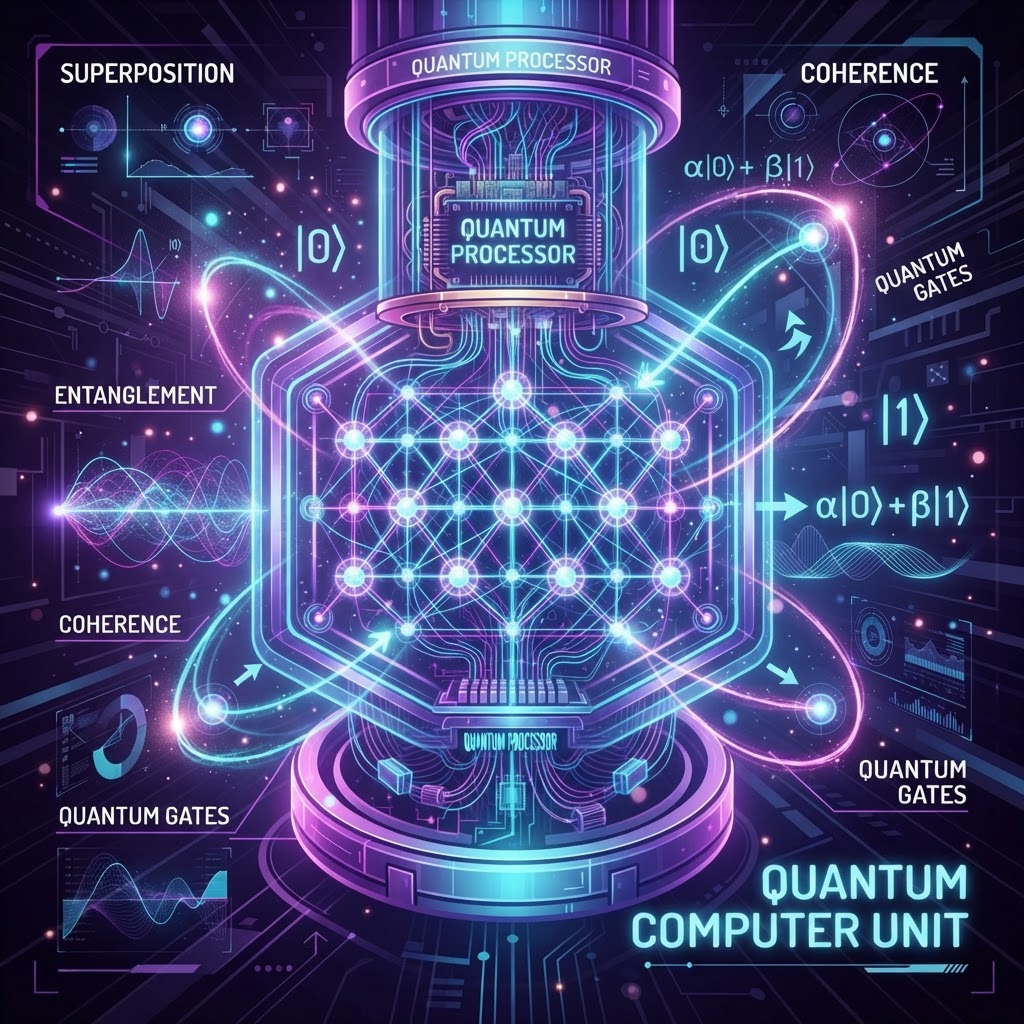
Quantum computing is a transformative field of technology that leverages the principles of quantum mechanics to process information at speeds exponentially faster than traditional classical computers. By utilizing the fundamental behavior of subatomic particles, these machines transcend the binary limitations of ones and zeros, opening new horizons for solving complex problems that currently remain intractable. In the rapidly evolving landscape of 2026, researchers are shifting from theoretical frameworks toward practical applications in cryptography, pharmaceutical design, and advanced material science. This evolution represents not just an incremental improvement in hardware power, but a complete paradigm shift in how we approach global computational challenges that require massive parallel processing and probabilistic analysis. For kids: Imagine a normal computer as a person who can only walk through a maze one path at a time, but a quantum computer is like a ghost that can walk through every path all at once to find the exit instantly. ## 1. What It Is At its core, a quantum computer functions by manipulating quantum-bits, or qubits, which exist in states far more complex than the binary switches of standard semiconductors. While a classical bit can only be a 0 or a 1, a qubit exploits the phenomenon of superposition to exist in both states simultaneously until observed. Furthermore, these machines utilize quantum-entanglement, a unique state where the condition of one particle is intrinsically linked to another, regardless of the physical distance between them. This interconnectedness allows for a level of data density that scales exponentially rather than linearly. As physical hardware improves, the ability to maintain these delicate states, known as coherence, continues to be the primary focus for engineers aiming to build stable, error-corrected systems for enterprise use. ## 2. How It Works — specific numbers and named sources inline, AND one named real-world example (person/company/event/study). The operation of a quantum computer relies on specialized cooling systems, often keeping processors at temperatures near absolute zero, roughly 0.015 Kelvin, to minimize external interference that causes decoherence. According to research from the Massachusetts Institute of Technology, error correction protocols are now capable of reducing logical error rates by a factor of 10 for every 100 physical qubits added to an array. A landmark example is the work done by IBM with their Eagle processor, which successfully demonstrated a 127-qubit system that pushed the boundaries of what is considered quantum supremacy. This specific development, documented in the journal Nature, showed that high-fidelity logic gates could maintain stability long enough to execute algorithms that would take a traditional supercomputer thousands of years to replicate. By performing thousands of simultaneous operations per clock cycle, these systems reduce complex search and optimization tasks to mere seconds of processing time. ## 3. Why It Matters The societal implications of this technology are profound, particularly regarding the ability to simulate molecular structures for drug discovery. By modeling the quantum states of atoms, scientists can predict the efficacy of new medications without the need for decade-long laboratory trials. Furthermore, the field of quantum-cryptography promises a future of unbreakable encryption, ensuring data security even against future computational threats. This shift is expected to revolutionize logistics, where optimization algorithms can determine the most efficient shipping routes across global supply chains in real time, saving billions of dollars in fuel and labor costs. | Feature | Classical Computer | Quantum Computer | | :--- | :--- | :--- | | Core Unit | Bit (0 or 1) | Qubit (0, 1, or both) | | Processing Mode | Sequential | Massive Parallelism | | Scaling Ability | Linear growth | Exponential growth | | Best Use Case | General daily tasks | Complex optimization | ## 4. In Summary — 2-3 sentence recap. Quantum computing represents a massive leap in computational capability by harnessing the subatomic laws of nature to solve problems that were previously thought to be impossible. By transitioning from bits to qubits, society stands on the threshold of unprecedented breakthroughs in science, security, and global infrastructure. ## 5. Further Reading https://en.wikipedia.org/wiki/Quantum_computing https://www.nature.com/subjects/quantum-computing https://science.nasa.gov/science-research/quantum-computing/ https://www.nist.gov/quantum
Common Misconceptions
Quantum computers will replace my laptop and make the internet faster.
Quantum computers are specialized tools for complex scientific and mathematical problems; they offer no performance benefits for standard tasks like browsing the web or word processing.
Quantum computers are just faster versions of current supercomputers.
Quantum computers operate on a different mathematical paradigm; they are not inherently 'faster' but rather solve certain problems using fundamentally different algorithms that require exponentially fewer steps.
Frequently Asked Questions
How is a qubit different from a bit?
A classical bit is always either a 0 or a 1, whereas a qubit can represent both states simultaneously due to superposition.
Why do quantum computers need to be very cold?
Qubits are extremely sensitive to heat and environmental noise, which cause errors, so they must be kept at temperatures near absolute zero to remain stable.
Will quantum computers replace my laptop?
No, quantum computers are designed for massive, complex calculations that classical computers cannot handle, not for daily tasks like browsing or word processing.
What is quantum entanglement?
Entanglement is a phenomenon where two qubits become linked such that the state of one instantly influences the other, regardless of how far apart they are.
Key Terms
- Superposition
- The ability of a quantum system to exist in multiple states at once until it is measured.
- Decoherence
- The loss of quantum information caused by interaction with the surrounding environment.
- Qubit
- The basic unit of quantum information, capable of existing in a state of superposition.
- Quantum Coherence
- The state where qubits maintain their quantum properties, allowing them to perform complex calculations.
Written by
Priya Sharma
AI & Technology Editor
Priya Sharma is the AI & Technology Editor at ExplainItSimple.AI. She holds a BSc in Computer Science from IIT Delhi and has worked as a machine learning engineer before moving to science communication. She specializes in making AI, software, and emerging tech understandable without a CS degree.
BSc Computer Science, IIT Delhi
View full profile📖 Get AI explanations on related topics:
Explore Quantum Computing at every level
Get a Quantum Computing explanation tailored for Kid, Teen, and Expert levels — with cited sources and follow-up quizzes.
Explain Quantum Computing for me