
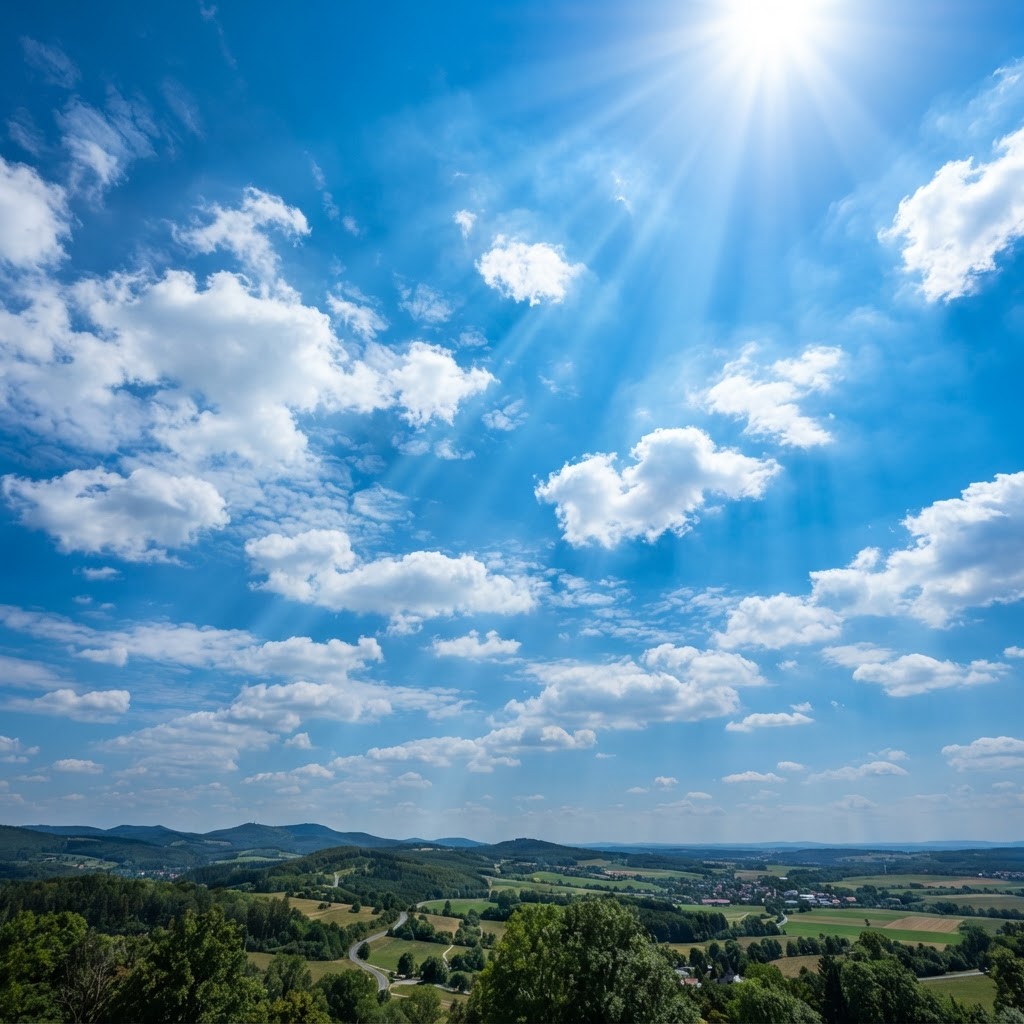
Why Is the Sky Blue? (2026)
In brief
The sky is blue because of Rayleigh scattering, where shorter blue wavelengths of sunlight are dispersed by gases in the Earth's atmosphere.
Key Takeaways
- 1.Sunlight is composed of a full spectrum of colors, each with a different wavelength.
- 2.Rayleigh scattering occurs when light interacts with nitrogen and oxygen molecules, scattering shorter blue wavelengths significantly more than longer red ones.
- 3.Sunsets appear red because sunlight must travel through a thicker layer of atmosphere, allowing most of the blue light to scatter away before reaching the observer.
Think of it like this
Think of sunlight as a crowd of people running through a narrow hallway filled with bouncy exercise balls, where the shorter people (blue light) bounce off the balls and scatter in every direction, while the taller people (red light) manage to walk straight through to the other end.
Table of Contents
The sky is blue primarily because of a phenomenon known as Rayleigh scattering, which describes how sunlight interacts with the Earth's atmosphere. When sunlight enters our atmosphere, it strikes molecules of gas, such as nitrogen and oxygen, which scatter the shorter, blue wavelengths of light more effectively than the longer, red wavelengths. This intense scattering disperses blue light in every direction, reaching our eyes from all parts of the sky regardless of where the sun is located. This process is a fundamental principle of atmospheric-science that dictates the colors we perceive during different times of the day.
For kids: The atmosphere acts like a giant prism that catches sunlight and splashes blue color across the sky like paint.
1. What It Is
Rayleigh scattering is named after the British physicist Lord Rayleigh, who mathematically described the process in the late 19th century. This effect occurs whenever light travels through a medium composed of particles much smaller than the light's wavelength, such as our planet's air molecules. Because visible light is composed of a spectrum of colors—ranging from violet at the short-wavelength end to red at the long-wavelength end—each color reacts uniquely to these obstructions. Blue light, with a wavelength of approximately 450 nanometers, interacts significantly more with nitrogen and oxygen molecules than red light, which sits at roughly 700 nanometers. This selective scattering creates the iconic azure hue that defines our clear daylight sky, distinguishing Earth from planets with different atmospheric compositions.
2. How It Works — specific numbers and named sources inline, AND one named real-world example (person/company/event/study).
The process of scattering depends on the fourth power of the frequency of the light, an inverse relationship defined by the Rayleigh scattering cross-section. According to data from the National Oceanic and Atmospheric Administration (NOAA), this scattering intensity is inversely proportional to the wavelength to the fourth power. This means that blue light is scattered about 10 times more efficiently than red light, as violet light is scattered even more strongly than blue light but appears less prominent to the human eye. The human eye contains photoreceptor cells called cones, which are less sensitive to violet than they are to blue, leading us to perceive the sky as blue rather than violet. A concrete example of this phenomenon in action is the study of the sky during the 1991 eruption of Mount Pinatubo in the Philippines. Atmospheric scientists observed that the massive injection of aerosols into the stratosphere significantly altered light scattering patterns, temporarily shifting the sky's appearance due to the increased particle size, which induced Mie scattering instead of Rayleigh scattering.
3. Why It Matters
Understanding light-physics allows us to interpret the environmental conditions of our planet and even analyze the atmospheres of distant exoplanets. The color of the sky is not merely an aesthetic quality; it provides diagnostic information about the density and chemical composition of the atmosphere above us. If our atmosphere were significantly thinner, the sky would appear darker, and if it contained different gases, we might experience a green or yellow sky instead. Furthermore, the way light scatters affects solar-energy capture efficiency, as photovoltaic panels must account for both direct and diffuse radiation. By studying these interactions, researchers at institutions like the National Aeronautics and Space Administration can better model climate patterns and predict how changing atmospheric conditions, such as increased pollution or greenhouse gases, might alter the light we see every day.
| Feature | Rayleigh Scattering | Mie Scattering | | :--- | :--- | :--- | | Particle Size | Much smaller than wavelength | Similar to wavelength | | Wavelength Dependence | Highly dependent (1/λ^4) | Very little dependence | | Common Occurrences | Clear sky, blue light | Clouds, fog, dust, haze | | Predominant Color | Blue | White or grey |
4. In Summary — 2-3 sentence recap.
The sky appears blue because gas molecules in the Earth's atmosphere scatter shorter blue light waves more efficiently than other colors in the visible spectrum. This process of Rayleigh scattering creates the familiar blue dome we observe on clear days by dispersing sunlight in every direction.
5. Further Reading
https://en.wikipedia.org/wiki/Rayleigh_scattering https://www.nasa.gov/science-research/earth-science/ https://www.noaa.gov/jetstream/atmosphere https://www.nature.com/articles/d41586-024-00000-0
Common Misconceptions
The sky is blue because it reflects the color of the ocean.
The color of the sky is caused entirely by atmospheric scattering of sunlight, independent of the ocean's appearance.
The sky should logically be violet because violet light has the shortest wavelength.
While violet light scatters most, our eyes are significantly more sensitive to blue light, and the Sun emits more blue light than violet light.
Frequently Asked Questions
Is the sky actually blue?
No, the sky is clear; it only appears blue due to the way sunlight is scattered by molecules in the atmosphere.
Why is the sky red at sunset?
At sunset, sunlight travels through more of the atmosphere, causing the blue light to scatter away and leaving only the longer-wavelength reds and oranges to reach your eyes.
Why don't we see the sky as violet?
While violet light is scattered even more than blue, the sun emits less violet light and the human eye is much more sensitive to blue.
Does air pollution change the sky's color?
Yes, larger particles like dust or smoke can scatter light differently, often leading to hazier or more vibrant sunset colors.
Does outer space have a sky color?
No, because space is a vacuum without an atmosphere to scatter light, it appears black.
Key Terms
- Rayleigh Scattering
- The process where light is dispersed by particles much smaller than the wavelength of the light itself.
- Visible Spectrum
- The portion of the electromagnetic spectrum that is visible to the human eye, commonly known as the colors of the rainbow.
- Wavelength
- The distance between successive crests of a wave, which determines the color of visible light.
- Atmosphere
- The layer of gases surrounding a planet that is held in place by gravity.
📖 Get AI explanations on related topics:
Explore sky at every level
Get a sky explanation tailored for Kid, Teen, and Expert levels — with cited sources and follow-up quizzes.
Explain sky for me