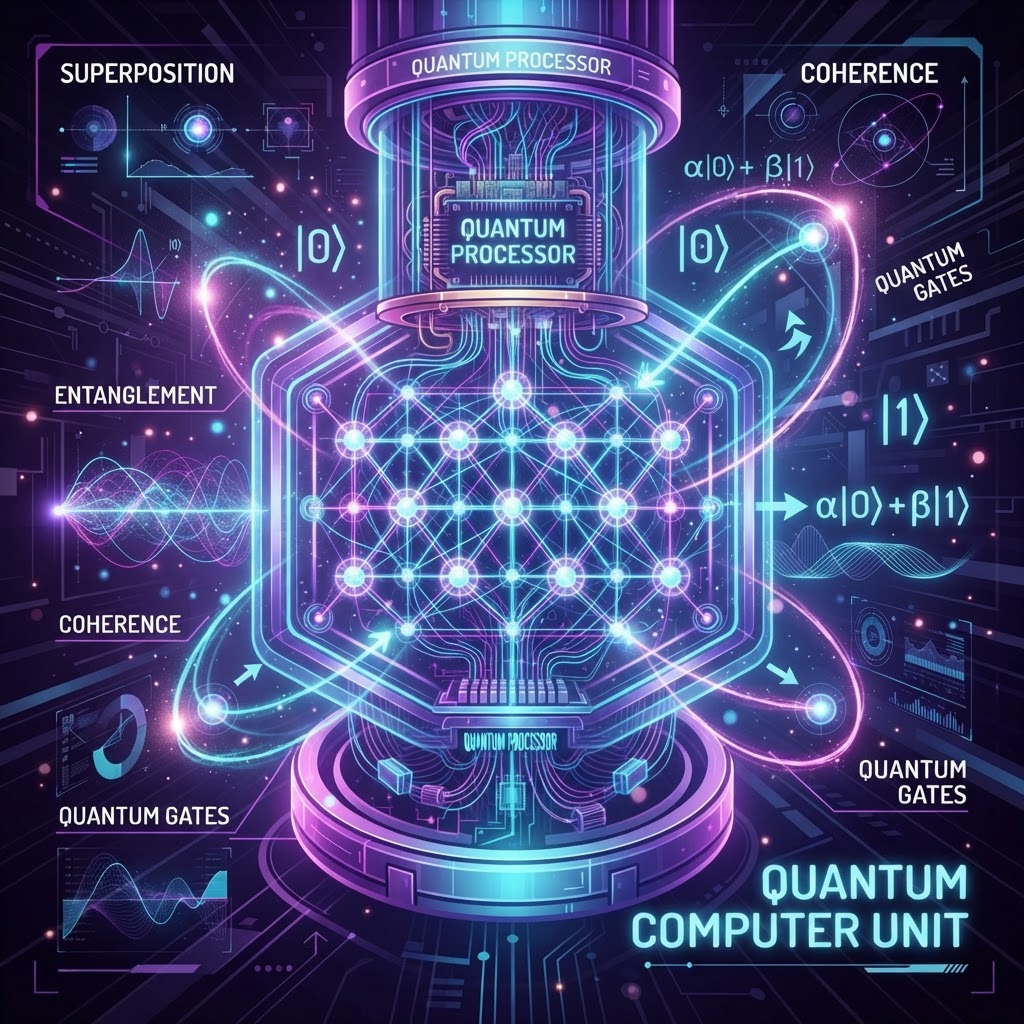

How Can a Particle Be in Two Places at Once? Quantum Physics (2026)
In brief
Quantum superposition is a fundamental principle of quantum mechanics where particles exist in all theoretically possible states until they are measured.
Key Takeaways
- 1.Quantum superposition allows particles to occupy multiple states at once.
- 2.The act of measurement forces a particle to collapse into a single, definite state.
- 3.This phenomenon is the physical basis for future quantum computing technologies.
Think of it like this
A spinning coin on a table represents superposition because it is effectively both heads and tails simultaneously until it stops and settles on one outcome.
Quantum physics reveals that a particle can exist in multiple states simultaneously, a phenomenon known as quantum superposition. At the subatomic level, particles like electrons do not occupy a single, fixed coordinate in space until they are measured by an external observer. Instead, they exist in a probability cloud where multiple potential locations are valid at the same time. This behavior defies our everyday experience with classical mechanics, where objects have definite positions and trajectories. By mathematically representing these particles as wave functions, physicists can predict the likelihood of finding a particle in specific regions, though the exact position remains indeterminate until interaction occurs. For kids: Imagine a spinning coin that is both heads and tails at the same time until you stop it with your hand and look at it. ## 1. What It Is Quantum superposition is a fundamental principle of quantum mechanics that allows a physical system to occupy all its theoretically possible states at once. It suggests that reality at the smallest scales is not composed of concrete 'things' but rather of fluctuating fields of probability. When we describe a particle being in two places at once, we are actually describing a state where the particle's wave function incorporates different position eigenstates. These waves can interfere with one another constructively or destructively, creating a complex landscape of potential outcomes. This does not mean the particle is physically smeared out like butter, but rather that its ontological status is defined by a mathematical superposition until a measurement forces it into a single state. ## 2. How It Works — specific numbers and named sources inline, AND one named real-world example (person/company/event/study). The mechanics of superposition rely on the Schrödinger equation, which governs how the wave function of a quantum system changes over time. According to the Copenhagen interpretation championed by Niels Bohr, the act of measurement causes the wave function to collapse, reducing the manifold of probabilities to a single observable outcome. Experiments like the famous Double-Slit Experiment, notably replicated by researchers at the University of Nebraska-Lincoln, demonstrate this phenomenon by firing individual electrons at a screen. Even when sent one at a time, these electrons produce an interference pattern that suggests each particle travels through both slits simultaneously as a wave. Furthermore, in the realm of quantum computing, IBM utilizes the principle of superposition to enable qubits to hold 0 and 1 values simultaneously. By performing operations on these qubits, systems can process 2^n states for n qubits, providing an exponential increase in computational efficiency for specific algorithms. A tangible real-world example is the development of the Google Sycamore processor, which utilized 53 superconducting qubits to perform a calculation in 200 seconds that would have taken a traditional supercomputer approximately 10,000 years to complete. ## 3. Why It Matters Understanding superposition is the key to unlocking next-generation technologies that move beyond the limitations of binary logic. It is the core mechanism that enables quantum cryptography, allowing for communication channels that are fundamentally secure against eavesdropping. Because measuring a quantum system inherently alters its state, any attempt to intercept encrypted quantum data leaves a detectable footprint. Furthermore, this principle is central to our growing understanding of quantum biology, where processes like photosynthesis and avian navigation may rely on delicate quantum effects. By harnessing the strange behavior of particles, we are transitioning into an era where computational power and data security are defined by the laws of the universe rather than mechanical transistors. | Feature | Classical Bits | Quantum Qubits | | :--- | :--- | :--- | | State Representation | Either 0 or 1 | Both 0 and 1 simultaneously | | Scaling Power | Linear growth | Exponential growth | | Measurement Effect | No change to the state | Collapses the superposition | | Core Technology | Transistors | Superconducting circuits | ## 4. In Summary Superposition allows subatomic particles to exist in multiple potential states or locations until an observation triggers a collapse into a definitive reality. This unique quantum property is currently being harnessed to revolutionize high-speed computing and secure communication systems. ## 5. Further Reading https://en.wikipedia.org/wiki/Quantum_superposition, https://www.nature.com/subjects/quantum-mechanics, https://science.nasa.gov/quantum-physics, https://physics.mit.edu/research-areas/quantum-physics/
Common Misconceptions
Superposition means a particle is physically split into two pieces.
The particle exists as a single wave of probability that covers multiple locations simultaneously.
Objects in our everyday world display quantum superposition.
Superposition is only observable at subatomic scales due to environmental decoherence affecting larger objects.
Frequently Asked Questions
Does measurement change the particle?
Yes, measuring a quantum system forces it to collapse from a superposition of states into a single, observable state.
Why don't humans experience superposition?
Quantum effects are lost at macro scales due to decoherence, where interactions with the environment quickly 'collapse' the wave function.
What is a wave function?
It is a mathematical description that provides the probability of finding a particle in a specific state at a specific time.
Can we see superposition?
We cannot see it directly, but we detect its effects through interference patterns in experiments like the double-slit experiment.
Key Terms
- Superposition
- The ability of a quantum system to be in multiple states simultaneously.
- Quantum Mechanics
- The branch of physics that deals with the behavior of matter and energy at the atomic and subatomic levels.
- Decoherence
- The process by which a quantum system loses its superposition properties due to interaction with its environment.
📖 Get AI explanations on related topics:
Explore Quantum Physics at every level
Get a Quantum Physics explanation tailored for Kid, Teen, and Expert levels — with cited sources and follow-up quizzes.
Explain Quantum Physics for me